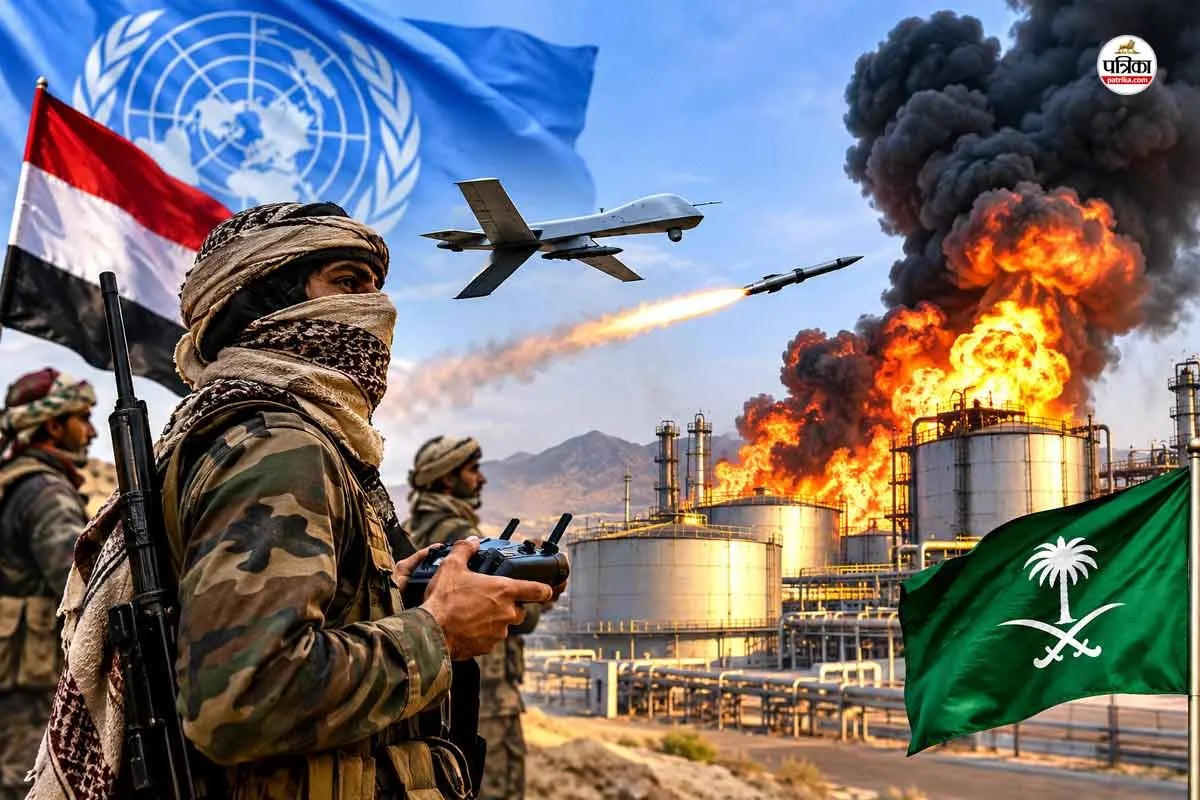
Yemen's Houthi rebels have claimed they targeted Saudi Arabia's oil installations and military sites. Meanwhile, the UN Security Council has agreed to extend sanctions related to Yemen.
Houthi military spokesperson Yahya Saree said the group's fighters stepped up action against Saudi Arabia. He said they targeted a pumping station of the East-West oil pipeline, an oil facility in Yanbu on the Red Sea coast, and military sites. There has been no independent confirmation of damage at any of these sites.
Major General Turki al-Maliki, spokesperson for the Saudi-led military coalition, said air defence systems intercepted suspected Houthi drones in mid-air over Riyadh and the country's Eastern Province.
Why Is the World Watching Saudi Oil Supply?
The most sensitive aspect of the development is Saudi Arabia's East-West pipeline. It connects the country's eastern oil fields to the Red Sea port of Yanbu. According to a Reuters report, Saudi Arabia is transporting about 40 lakh barrels of crude oil a day through the pipeline. This is roughly four per cent of the world's total oil supply.
With tension already continuing in the Strait of Hormuz, the pipeline serves as an alternative export route for Saudi Arabia. An attack on this infrastructure could raise concern in the global energy market.
UN Extends Yemen Sanctions
Meanwhile, the UN Security Council unanimously decided to extend Yemen-related sanctions for a year. These include provisions such as a freeze on the assets of the persons concerned and travel bans. The council has also urged the Houthis to stop cross-border attacks and military tension. The term of the panel of experts monitoring the sanctions has also been extended.
Humanitarian Crisis Deepens in Yemen
The military confrontation is also affecting civilians. According to the UN Office for the Coordination of Humanitarian Affairs (OCHA), more than 3.33 lakh people have been displaced in Yemen since August. More than 24,000 of them were displaced in the past week alone. Continuing violence is affecting health services and making it difficult for relief agencies to reach those in need.
Red Sea Shipping Route Also a Concern
Yemen's geographical position adds to the importance of the conflict. The Red Sea and the Bab al-Mandeb Strait are among the main routes of international maritime trade. If the movement of ships there is affected, pressure could grow on goods transport between Asia and Europe, insurance costs and the energy market. The Security Council has also stressed the need to protect ships from threats and attacks.
Path to Peace Still Difficult
The UN has made clear that the Yemen crisis cannot be resolved through military action alone. Dialogue and political agreement among all sides are necessary. On the other hand, Saudi Arabia's security concerns and the Houthis' continuing military activity are not letting regional tension ease.