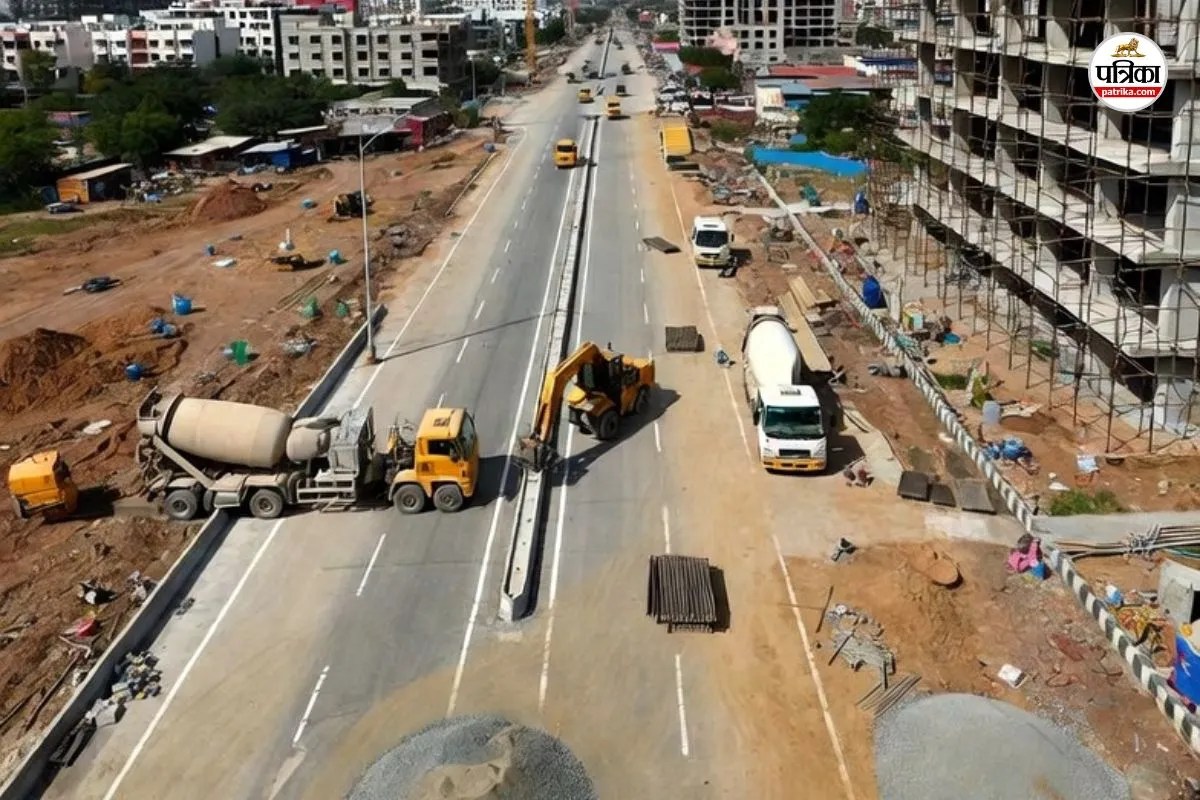
Bharatpur city will be transformed in a year. A six-lane road will be constructed from RBM Hospital to Chandpole Gate. The BDA has issued the work order.
A significant step has been taken towards making the Circular Road in Bharatpur city smoother and safer. The government will construct a 6-lane road from RBM Hospital to Chandpole Gate. The Bharatpur Development Authority (BDA) has issued the work order for this. The work on the 6-lane road will commence once the flyover construction is completed, which will provide significant relief to the city residents in terms of traffic.
A four-lane flyover is being constructed on the Circular Road from Kali Ki Bagichi to RVM Hospital and from Hira Das Chowk to Chandpole Gate. Once the flyover is completed, a 6-lane road, approximately 3 km long, will be constructed from RBM to Chandpole Gate. This project will cost around ₹28 crore. The road construction will include the installation of dividers, and electricity lines will be laid underground. Modern road lights will also be installed.
The Bharatpur Development Authority (BDA) is completing the survey and other formalities in coordination with the Public Works Department and the Municipal Corporation. BDA Commissioner Kanishka Kataria stated that the road widening is being done as per the Chief Minister's directives. A 36-metre-wide road is proposed under the Master Plan. However, due to the CFCF on one side and the RNFCF on the other, a 6-lane road will be constructed according to the available land on site.
The Circular Road has been divided into four parts, with flyovers to be built in two parts and a 6-lane road in the other two. The work order for the 6-lane road has been issued. Three lanes will be constructed on each side, and interlocking tiles will be laid on the edges, which will further increase the width of the road.
BDA's Superintending Engineer Yogesh Mathur informed that the 6-lane road will be constructed using the Thin White Topping technology. This is a modern technique where a thin layer of cement concrete is laid over the existing road. This technique is considered particularly suitable for urban and waterlogged areas. It makes the road stronger, more durable, and longer-lasting.
1- The road will be more durable and long-lasting.
2- Damage caused by waterlogging will be reduced.
3- Maintenance costs will be lower.
4- The road will be suitable for heavy traffic.
5- Improved ride quality and road safety will be achieved.
6- Environmentally friendly technology will be used.