18 October 2026,
Sunday

18 October 2026,
Sunday
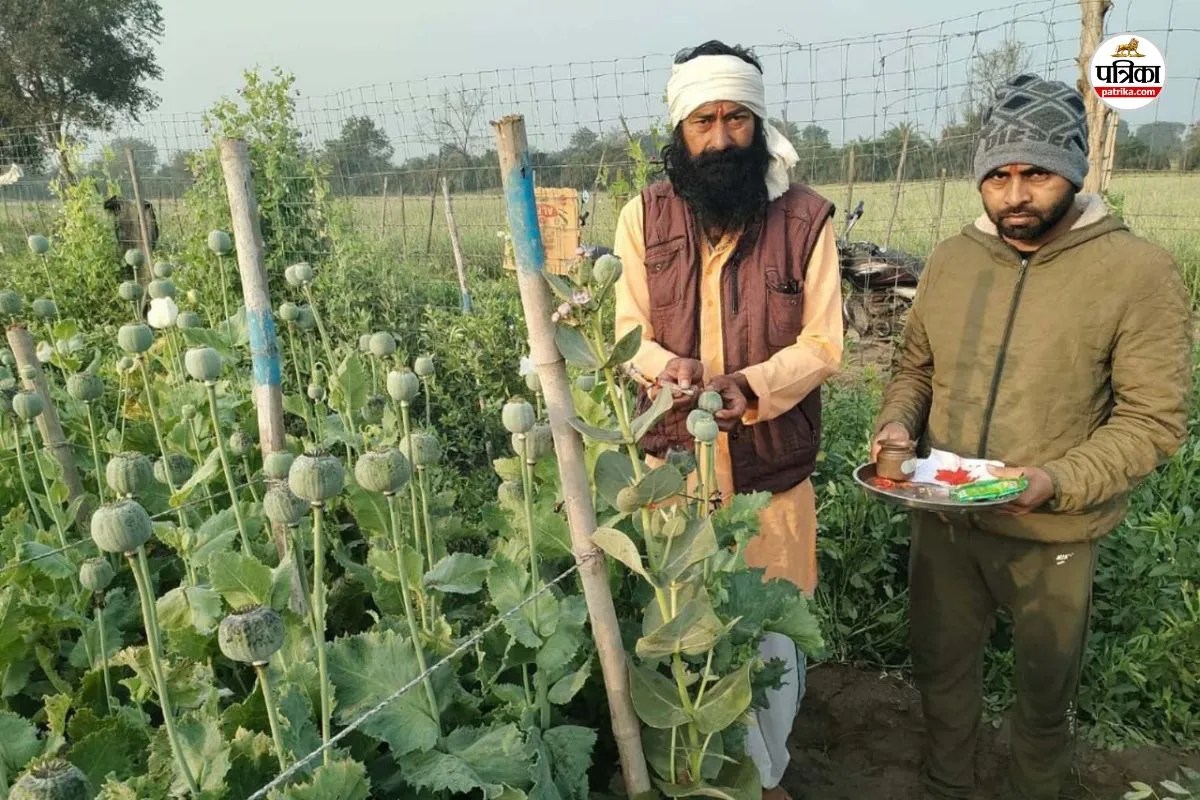
Farmers perform prayers before making incisions on opium pods in a field in Semla, Sunel area. Photo: Patrika
Rajasthan Opium Crop: In the Sunel region of Jhalawar, the scoring of opium pods has begun, with the installation of a statue of Maa Kalika in the fields. The care farmers take in nurturing the opium crop can be gauged by the fact that after sowing, they never enter the field wearing footwear.
In the Sunel and surrounding areas, farmers commenced the 'luwai-chirai' (harvesting and scoring) of the opium crop, referred to as 'black gold', which has reached maturity. This was done after performing religious rituals and worshipping Maa Kalika during an auspicious time. Farmers believe that praying to Maa Kalika for a good yield and prosperity, and then scoring the pods, is a tradition locally known as 'Naana'.
Farmers bring puja materials from their homes to the fields. They then establish the deity's idol on a raised platform in the plot, tie a sacred thread, light a ghee-oil lamp, offer incense sticks, and present a coconut. Following this, they tie a coloured thread around five plants, score the pods, and pray for a bountiful harvest. The farmers are eagerly awaiting the fifth instalment of the Mukhyamantri Kisan Samman Nidhi Yojana, with 74 lakh farmers in Rajasthan anticipating the release.
Farmers from Semla village, including Mohanlal Meghwal, Babulal Meghwal, Harinarayan Sharma, Ramkaran Meghwal, and Mahavir Prasad Meghwal, stated that the tradition of worshipping the mother goddess before 'Naana' has been ongoing for a long time. The scoring of the pods is done during the day using a special tool called 'Nakka'. The following morning, after the puja, the opium latex is collected using scrapers. After the 'luwai-chirai', poppy seeds are extracted from the dried pods.
Although there is a provision to destroy the poppy husk in the fields, it is still smuggled. Smugglers' activities increase in the border areas of Madhya Pradesh and the Sunel region as soon as opium is sown. Opium cultivation is monitored by the Central Bureau of Narcotics, but the risk of illegal activities escalates once the pods are scored. The government has rights over the opium cultivated in the fields.
Cases have also emerged where the weight of pure opium is increased by mixing it with other powders. For instance, powders like coffee or Bournvita are added to half a kilogram of pure opium, increasing its weight to two and a half to three kilograms.
During the harvesting period, farmers build huts in their fields and reside there, guarding the crop day and night. Their daily routine changes once the scoring of the pods begins. In most parts of the region, the scoring process has already commenced.