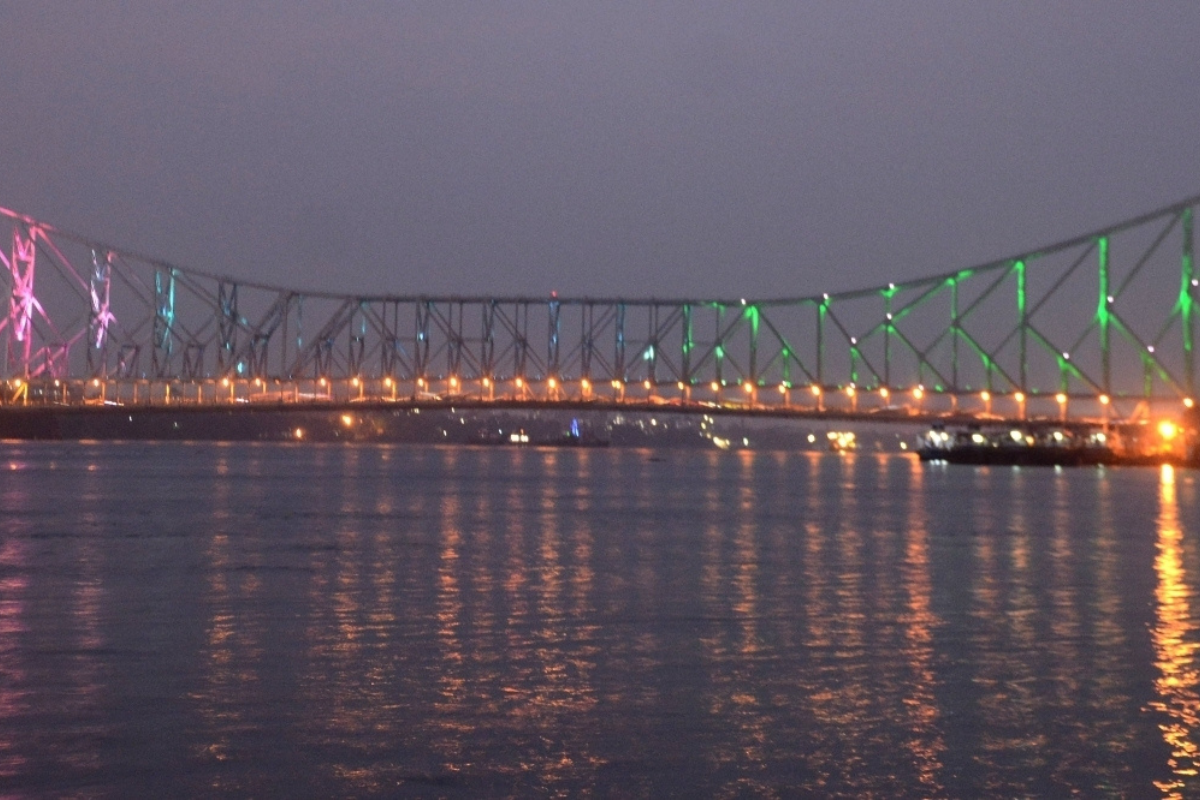
On 20 December 1942, Japanese army bombers heavily bombed the city of Calcutta (now Kolkata). Hundreds of lives were lost. Many buildings were damaged, but how did the Howrah Bridge survive? Read the special report.
Howrah Bridge Bombed by Japani Army: On this day, December 20, 1942, the Imperial Japanese Army Air Force seemed determined to devastate the city of Calcutta (now Kolkata). Japanese soldiers continued their nefarious intentions for two years to bring down the Howrah Bridge. But despite all this, the Howrah Bridge still stands firm in its place today. Read here how our bridge was saved?
In 1942, the entire world was engulfed in World War II. As part of the British Empire during World War II, India was also involved in the war as an ally of Britain. America also stood with Britain in this war.
During World War II, India was being used as a major air supply route, which was utilised for American military operations. American forces were flying over the Himalayas in India, and for this reason, it was known as 'Flying Over the Hump'.
However, flying over the Hump was extremely dangerous. Several American aircraft crashed during this mission. Despite all this, it was the only way for the Allied forces to send supplies to aid China in the war against Japan, and it also made it possible to avoid Japanese-occupied Burma. In early 1942, Japan's advance in Southeast Asia slowed down at the borders of India. The eastern Indian state of Calcutta, due to its proximity to China and Burma, remained a crucial centre for military operations.
By May 1942, the Japanese had captured Burma after defeating British and Chinese ground troops, and now they felt Calcutta was within their reach. British officials were also aware of this. This is why, to make it difficult for bomber pilots to accurately target their objectives, the city was plunged into darkness from sunset to sunrise. A curfew was imposed across the city. The city's electricity was cut off as soon as evening fell. Additionally, Kolkata's buildings were painted black.
The Japanese army knew that the British and Indian armies in India would not only easily thwart their daytime attacks but would also give a fitting reply. This is why the Japanese army attacked at night in India, under the cover of darkness. However, within a few months, the British and Indian armies left no stone unturned in thwarting Japan's night-time attacks and giving a suitable response.
There was peace in the city of Calcutta for a few months, and the threat of invasion seemed to have receded, but on the night of December 20, 1942, the Japanese army once again made its presence felt. On December 20, 1942, bombers of the Japanese Imperial Army Air Force heavily bombed the city, causing significant damage to many buildings. Japan's objective was also to destroy the Howrah Bridge, but due to the darkness in the city at night, the bombs fell on hotels located away from the bridge or elsewhere. However, the Japanese army continued its efforts for two years.
The British government had deployed an excellent air defence system in Calcutta. It was capable of responding effectively to any daytime attack. Japanese fighter pilots respected this strength. This is why the Japanese army only carried out air attacks at night and also ensured that they flew at a considerable altitude in the skies over Calcutta. The British military officials were astonished by the skillful night attacks of the Japanese army, but the British responded brilliantly thereafter.
British Air Force bomber pilots destroyed a large formation of Japanese fighter aircraft. These attacks also destroyed the Japanese flying boat base, ending Japan's ability to carry out long-range air attacks.
By 1943, Britain further strengthened its air defences by sending radar-guided night fighter aircraft to India. Subsequently, the British Air Force, using Spitfire aircraft, succeeded in destroying several of Japan's Mitsubishi Ki-21 and Mitsubishi Ki-46 aircraft. On the other hand, this initiative by Britain helped save many architectural marvels of Calcutta. The Howrah Bridge was one of them. However, the Japanese attack in 1943 caused heavy damage to property and loss of life at Calcutta's Kidderpore Port (now Shyama Prasad Mukherjee Port). Hundreds of people were killed in this attack, and many ships and warehouses were destroyed.
Japanese air bombing over Calcutta continued intermittently until 1944, but due to the acumen of British and Indian military officials, Calcutta and the Howrah Bridge were saved. After repeated failures, Japan deployed its fighter aircraft to other locations.