9 October 2026,
Friday

9 October 2026,
Friday
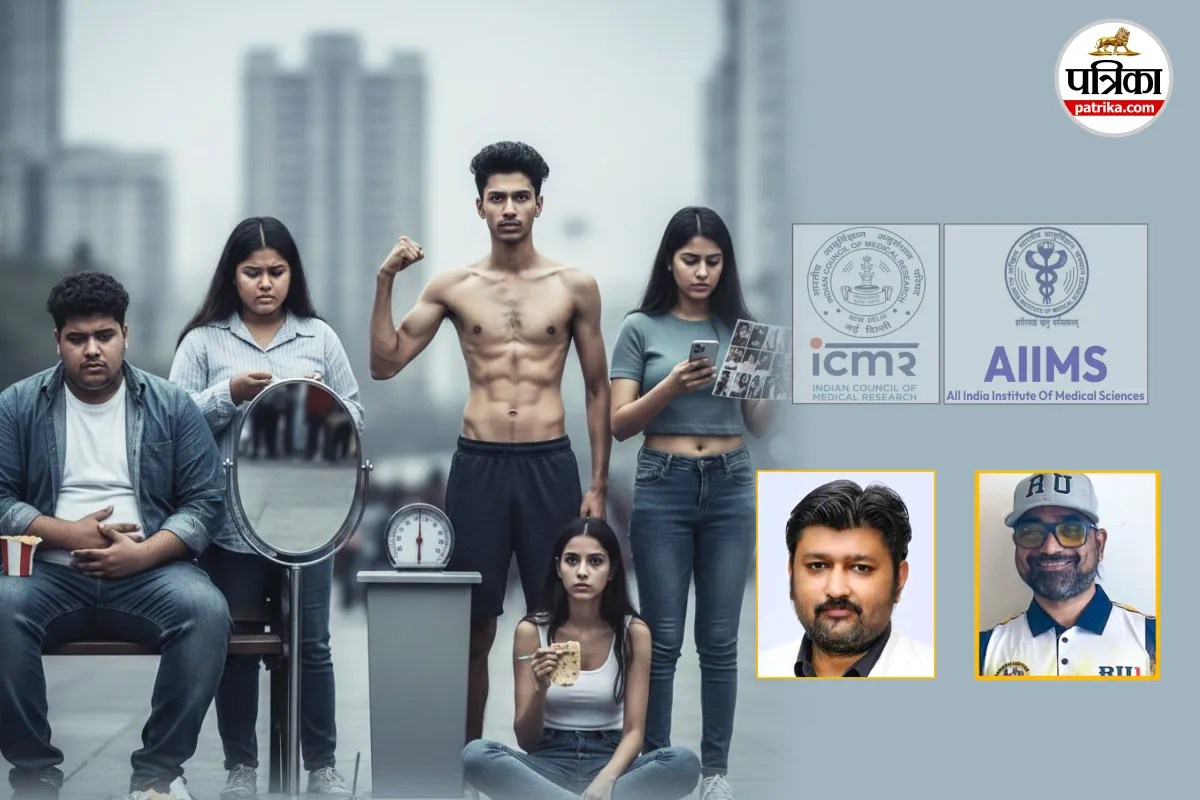
Image: Patrika
"This is a very big health issue that Indian youth have been struggling with for a long time. However, it is not discussed. It is so dangerous that this issue can escalate to suicide," said psychiatrist Dr. Aditya Soni, commenting on the Body Image Distress research report by AIIMS and ICMR. This report by AIIMS and ICMR has revealed that 'Body Image Distress' is now emerging as a major mental health problem among Indian youth.
The data from AIIMS and ICMR is published in the research 'Journal of Education and Health Promotion'. For this research, 1,071 youths aged 18 to 30 years were included. Approximately 49% of obese youths admitted to severe body image anxiety. Similarly, about 47% of underweight youths are also suffering from this stress. Among youths with normal weight, this figure was 36%.
The research also states that the likelihood of body image distress is twice as high in underweight youths and three times higher in obese youths compared to those with normal weight. It is noteworthy that one in every four youths feels they are being judged.
Psychiatrist Dr. Aditya Soni, who researched 'Body Image Distress' during his Doctor of Medicine (MD), explained how to deal with such stress.
Dr. Soni said, "Body image distress is a major mental problem. Excessive worry about one's body shape leading to depression is body image distress. People who are very thin or obese are more affected by this. Or, one could say that those who do not fit into society's perceived definition of beauty fall victim to this mental illness."
There are not one, but many reasons for body image distress. Social media has played a significant role in promoting it further. Advertisements are also a major factor. For instance, artificial means are used to portray fitness and beauty, and we, as ordinary people, accept these as reality.
Based on this, definitions of beauty and fitness are established. However, everyone's body and physique are not the same. Anyone who does not understand this has to grapple with body image distress. After all, we are human; if someone comments on our body, colour, or physique, how long can we cope? Therefore, such cases are increasing.
Experience 1 – A woman, requesting anonymity, shared, "I have been struggling with this since childhood. People think I am overweight, though I don't feel so. My close ones, friends, or others often give me advice on losing weight. Because of this, I feel demotivated. I don't feel like meeting people. Once someone talks to me like this, I end the relationship. It's not that it doesn't affect me, but I distance myself from such people to cope."
Experience 2 – A man, requesting anonymity, shared, "I am perfectly fit, but I have a bit of a belly. My friends and colleagues often comment on it. Especially when taking photos, I am told, 'Brother, tuck in that belly…'. Many men like me are commented on for their belly. Although it feels bad, I then console myself and don't get demotivated."
Experience 3 – Similarly, a young man said, "I am thin. That is, I look thinner than normal, but not weak. People call me names like 'Sukhtu' (a derogatory term for a very thin person)."
Dr. Aditya says, "It is important to understand the science of body composition and weight. Check your BMI. Get your fitness checked. If everything is fine, there is no need to be bothered by people's nonsense. Yes, if you are obese, there is a risk of disease, and if you are very thin, there is also a risk. Therefore, work on your own fitness."
Celebrity fitness trainer Rakesh Uddiyar says that going to the gym, exercising, and doing yoga not only keep the body fit but also strengthen it mentally. Therefore, we should work out regularly. Dr. Aditya agrees with this.
Furthermore, Dr. Soni states that awareness about this issue is crucial in society. It is not necessary to mock someone if they don't look "right" according to your standards. Instead, if someone is genuinely struggling with a physical problem, they should be supported.
Professor Piyush Ranjan of the Medicine Department at AIIMS said, "Weight management does not just mean losing weight. Often, young people abandon lifestyle programmes midway due to emotional problems. Therefore, along with nutritional care, psychological screening should also be mandatory."