13 September 2026,
Sunday

13 September 2026,
Sunday
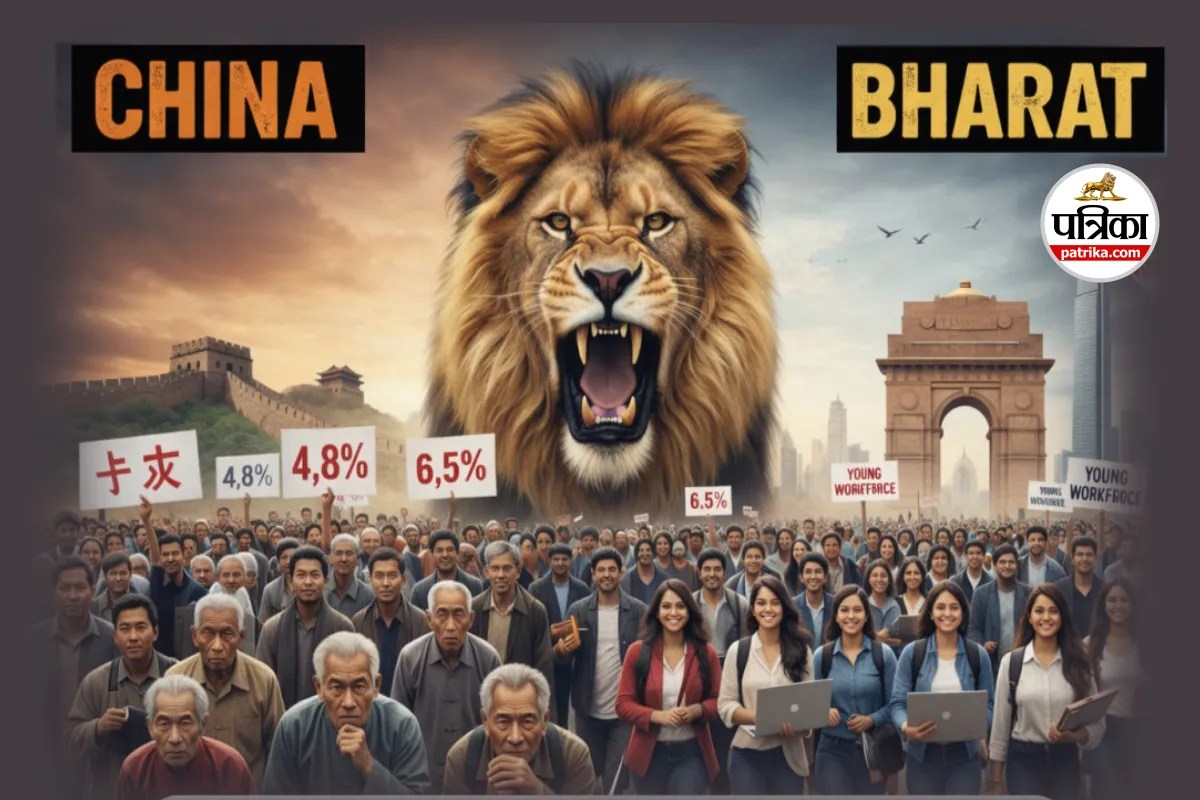
Image: Patrika
China and India are powerful nations in Asia, each holding a distinct global identity due to their populations and economies. China has established its reputation in terms of population and manufacturing. However, China is aging, and to rejuvenate its population, it is increasing the prices of condoms and contraceptive medicines. Meanwhile, India has surpassed China in population, and the country appears to be getting younger every day. Furthermore, India's influence is rapidly growing in the global manufacturing industry and digitalisation. Despite these developments, analyst KG Mao from the Chinese International Cooperation Centre has sparked a debate about China being the best.
Analyst KG Mao argues that the world is heading towards a transformation where China will be at the top, while America and India will battle it out for "second place."
KG Mao's argument has sparked discussions worldwide. Let's try to understand the data along with the arguments.
The year 2025 has not been favourable for China. According to a Bloomberg report, China recorded its first annual decline since 1998. Furthermore, the property crisis in China is still ongoing.
According to data from the Ministry of Statistics and Programme Implementation, India's real GDP grew by 8.2% in Q2 of FY 2025-26. This is higher than the previous quarter's 7.8% and Q4 of FY 2024-25's 7.4%. This has been possible due to strong domestic demand amidst global trade and policy uncertainties.
The RBI has revised India's GDP growth forecast for FY 2025-26 upwards from 6.8% to 7.3%. India's domestic growth is being driven by the following factors:
According to the International Monetary Fund (IMF) estimates for 2026, India's growth rate is projected to be 6.6%, while China's growth rate may decline to around 4.8%.
Meanwhile, China's population has been declining for three consecutive years. In 2026, to combat this population crisis, China increased taxes on condoms and other contraceptives to rapidly boost its population.
Over 65% of India's population is under 35 years of age. In contrast, China's working-age population (15-64 years) peaked in 2014 and has been declining steadily since then. In the new year 2026, India's average age is expected to be around 28-29 years, while China's average age is projected to exceed 39 years.
This means India has a young workforce, while China has an aging population.
Indeed, ageing is referred to as "demographic winter," which significantly impacts a country's development. China is not alone; many powerful nations worldwide are grappling with "demographic winter," and its adverse effects are evident:
Japan: It has the world's largest elderly population. Sales of adult diapers exceed those for babies. The government has implemented various schemes to boost the population.
South Korea: It has the world's lowest fertility rate (0.7).
Several European Countries: Countries like Italy, Germany, and Spain face a severe shortage of the workforce and have become dependent on migration.
Russia: It is experiencing a sharp decline in birth rates, signalling an economic crisis for the future.
In contrast, India's Total Fertility Rate (TFR) is around 2.0 (1.9 in 2023-24), while China's rate is approximately 1.0. Although India's birth rate is also declining, it is at a slower pace. China's graph is falling rapidly in this regard.
A declining birth rate impacts a country's development. This is one of the primary reasons why India is rising, while China is falling behind in this aspect. India's median age is only 28-29 years. See the advantages of this:
65% of India's population falls within the working-age bracket, which can make it the world's 'workforce engine' for the next two decades. However, this also depends on the effective utilisation of this young workforce.
One can observe how India is now surpassing China in manufacturing. Global giants like Apple and Tesla are shifting their supply chains from China to India. Additionally, initiatives like 'Make in India' and PLI schemes have made India the second-largest manufacturer of mobile phones and a significant defence exporter.
Moreover, India has long been the world's 'Back Office,' and now it is emerging as a leader in the digital economy through fintech (like UPI). The scope of UPI has also been expanded to several countries.
Thus, India is progressing with a green signal, while China's red signal is becoming a cause for concern. In this context, KG Mao's argument appears to be turning on its head.