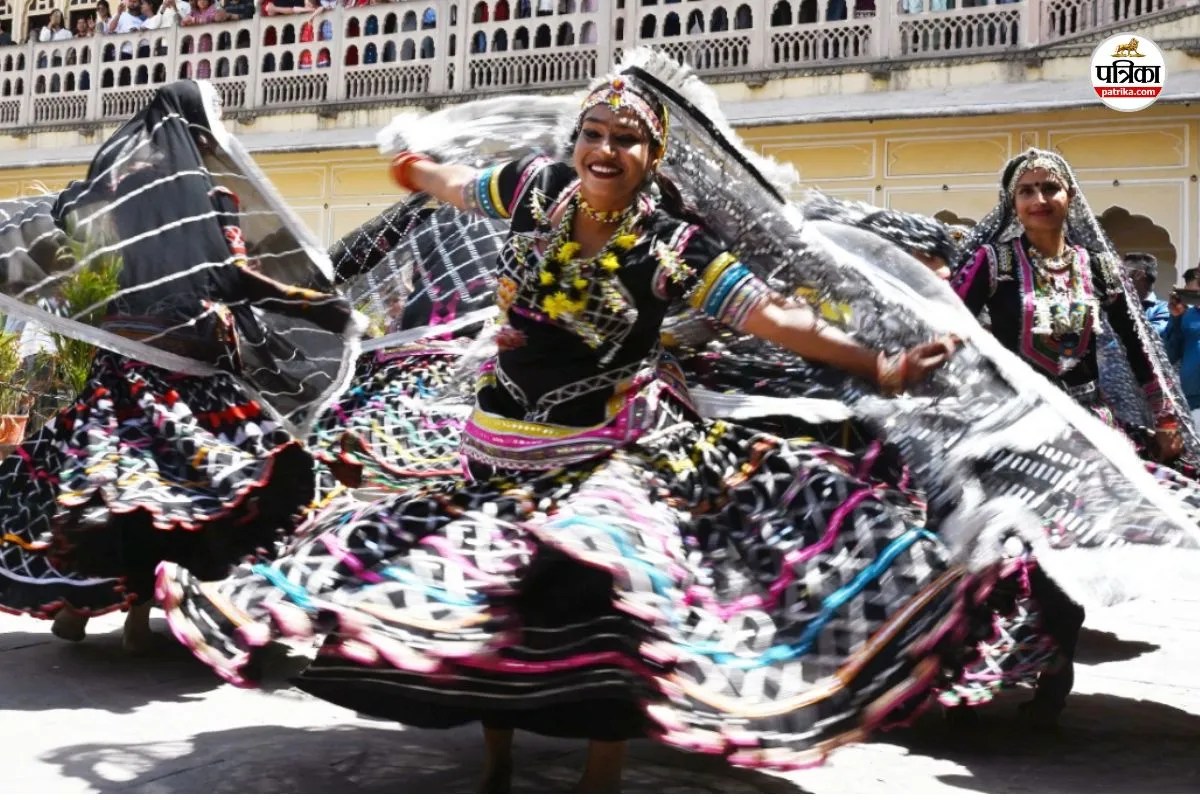
Rajasthan has a deep and vibrant connection with dance. In Rajasthan, dance is not just an art form but an integral part of culture, history, tradition, and life. The soil of Rajasthan embodies the rhythm of the desert, the grandeur of royalty, the echoes of folk tales, and the vibrancy of festivals. All of this finds expression in dance. The Ghoomar Festival will be celebrated in Rajasthan from November 19. With the discussion of the Ghoomar Festival, a question is on everyone's lips: how many main dances are there in Rajasthan? According to statistics, Rajasthan has many dances that attract domestic and foreign tourists.
A traditional folk dance of Rajasthan, Ghoomar. File Photo: Patrika
Ghoomar Dance – Gestures of the Hands Tell Stories
First, let's talk about Ghoomar dance. It is a traditional folk dance of Rajasthan. Primarily, women perform this dance wearing a ghagra (skirt), choli (blouse), and odhni (scarf). This is a famous circular dance of the Bhil and Rajput women. In this, the ghagra spins. The gestures of the hands tell stories. Ghoomar dance is mandatory during Holi, Gangaur, and Teej festivals.
Kalbelia dance is famous worldwide. Photo: Patrika
Kalbelia Dance – Foreigners Lose Themselves
The Kalbelia dance is famous worldwide. Foreigners are enamoured with this dance. UNESCO included the Kalbelia dance in the Intangible Cultural Heritage list in 2010. Kalbelia is the dance of the snake charmer community of Rajasthan. To the beat of the dholak and been (a wind instrument), women mesmerise the audience with the magic of their flexible bodies. This dance is performed wearing black kurtis, lehengas, and dupattas adorned with pieces of glass and zari (gold or silver thread embroidery).
The dance is performed wearing a horse costume. File Photo: Patrika
Kachchhi Ghodi Dance – A Male-Dominated Dance
Kachchhi Ghodi of Rajasthan is another famous dance. It is a male-dominated dance. In this, men dance to the beat of the dhol (drum) while wearing a horse costume. It is very entertaining to watch. This Kachchhi Ghodi is made of bamboo. It is decorated with cloth, gota (embroidery), and zari. Then reins are attached. In Rajasthan, this folk dance is performed in devotion to the folk deity Teja Ji.
A youth performing Gair dance. File Photo: Patrika
Gair Dance – Originating from the Bhil Community
The Gair dance art is seen during festivals like Holi and Janmashtami. Due to its circular formation, it was called "Gher" and later came to be known as "Gair". Those who perform the Gair dance are called "Gairiya". This famous folk dance is performed collectively by men in a circle, holding sticks and accompanied by musical instruments like dhol, bankiya, and thaali. The Gairiya dancers of Mewar wear white angarkha (long coat), dhoti, and saffron turbans, while the Gairiya of Barmer wear white ongi (long frock) and a leather strap for a sword. Its origin is from the Bhil community.
A scene from the Kathputli dance. File Photo: Patrika
Kathputli Dance – Depicting Folk, Mythological, and Social Issues
'Kath' means 'wood' and 'putli' means 'lifeless doll'. Kathputli is a famous dance show that depicts stories, folk tales, mythology, and some social issues, presented by Kathputli artists with specific music and singing. The dolls are mostly made of mango wood and filled with cotton, standing about one and a half feet tall. Kathputli artists operate and control them with the help of strings. This entertaining folk dance is over 1000 years old. The Bhat tribe of Rajasthan initiated it.
Dancers performing Terah Taali dance. File Photo: Patrika
Terah Taali Dance – Manjeeras Produce Melodious Sound
The Terah Taali dance originated from Padarla village in the Pali district of Rajasthan. Women of the Kamad tribe perform this dance. Women tie thirteen manjeeras (small cymbals) to their bodies and perform a lively and beautiful dance. When struck against each other, these manjeeras produce a melodious sound. Sometimes, they perform the folk dance with a sword in their mouths and a pot on their heads. Male artists sing folk songs. Men play various instruments like pakhawaj, dholak, jhanjhar, sarangi, and harmonium. The main performers, women, sit on the ground in front of the idol of Baba Ramdev and perform the dance.
Ghoomar Festival 2025 to be Held on November 19
The Ghoomar Festival 2025 will be organised simultaneously in all seven divisional headquarters of the state from November 19 in Rajasthan. These seven divisions include Jaipur, Jodhpur, Bikaner, Ajmer, Bharatpur, Kota, and Udaipur. The Ghoomar dance is an integral part of Rajasthan's cultural heritage.