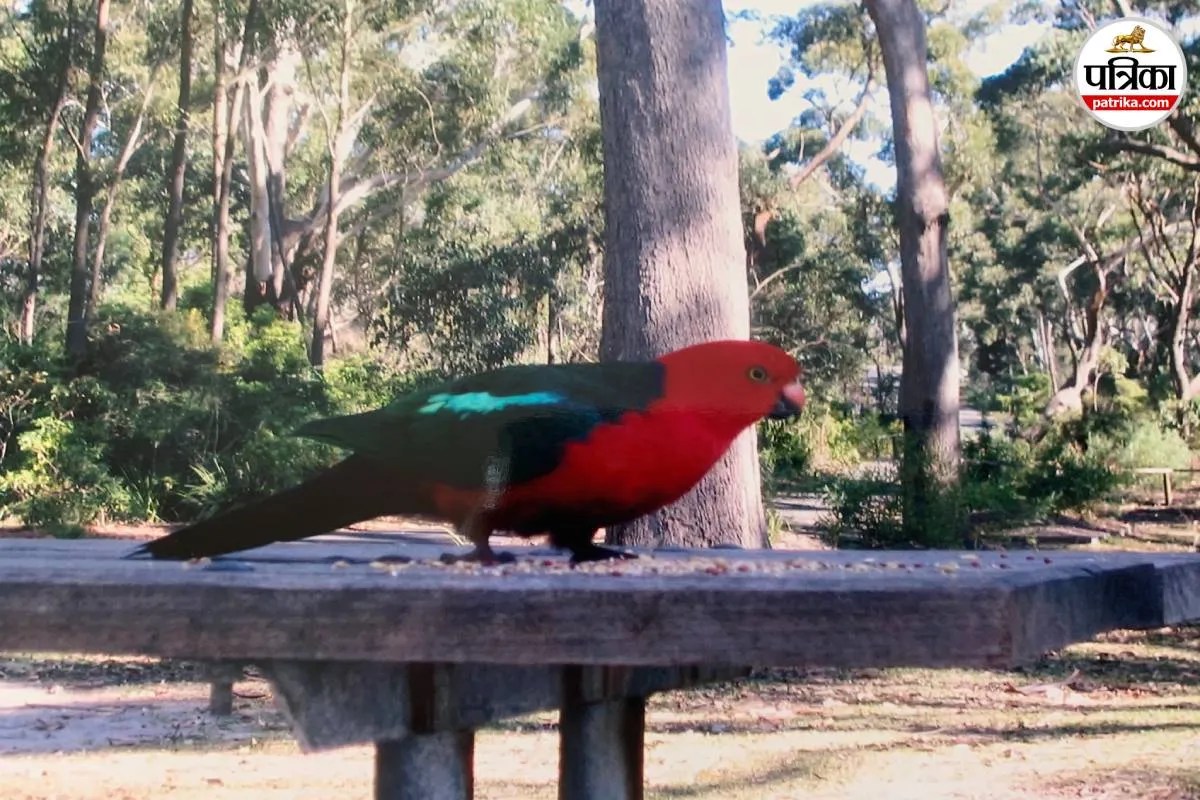
Pet parrots from Mexico are now thriving in the wild in Los Angeles, numbering in the thousands, as scientists unravel the mysteries of their adaptation and hybrids.
Los Angeles Wild Parrots: The city of Los Angeles in America is witnessing the reign of colourful parrots (LA Wild Parrots). These parrots were brought from Mexico and South America as pets, but now they (Red Crowned Parrots) are seen roaming freely on the city's streets and trees. Scientists are calling them 'kings of the urban jungle'. Their chirping can be heard in areas like Pasadena and Malibu, giving the city a tropical touch. Experts like researchers John McCormack and Diego Blanco from the Moore Laboratory at Occidental College are engaged in understanding their mysteries. These parrots are not only vibrant but are also teaching a lesson for the environment (Feral Parrots Conservation).
The story of these parrots begins in the 1970s. They were imported in large numbers for the pet trade. Celebrities also favoured them. However, due to incidents like a fire in a pet store, many parrots were freed. Initially, scientists ignored them, considering them an invasive species. But now they have blended into the city. An interesting anecdote is that a hybrid parrot died after colliding with a college library window. Investigations revealed that these had mixed genes never seen before in Mexico. Today, 25 parrot species are sustaining themselves in 23 states across America.
Currently, their numbers in Los Angeles are in the thousands. According to one study, there are over 3,000 Red-crowned parrots alone, which is considered a low figure. Lilac-crowned, Yellow-crowned, and Nanday Parakeets are also present. They live in flocks on palm trees and telephone poles. Genetic testing of 40-50 parrots in research has shown that they have adapted to urban heat, different trees, and rainfall. Hybrids are also being formed, where different species are combining to create new variations. They are adding colour to the city's biodiversity.
Significant conservation efforts are underway. In the Moore Laboratory, comparisons are being made with 100-year-old specimens of Mexican parrots. The FLAP Project (Free-flying Parrot Project) collects dead parrots, provided they are not heavily contaminated with insects. Nanday Parakeets are foraging on sycamore trees in the Santa Monica Mountains and may spread further into the Santa Ynez Range. McCormack says, "If they become extinct in the wild, they could be reintroduced from the city's parrots." Some scientists are advocating for giving them sanctuary status so that they are not considered invasive.
However, challenges are not few. California laws offer them only basic protection, preventing cruelty. In 2023, many parrots were trapped and killed. Urban changes – the cutting of palm trees has created difficulties in nesting. Researcher Jenal Ortiz asks, "Will they be able to shift to other trees?" Their loud squawks are fine for the wild, but they create noise in the city. Dennis Hennen of the Audubon Center says, "A bit noisy, but lovely." While not eagles, they face threats from hawks.