4 March 2026,
Wednesday


4 March 2026,
Wednesday
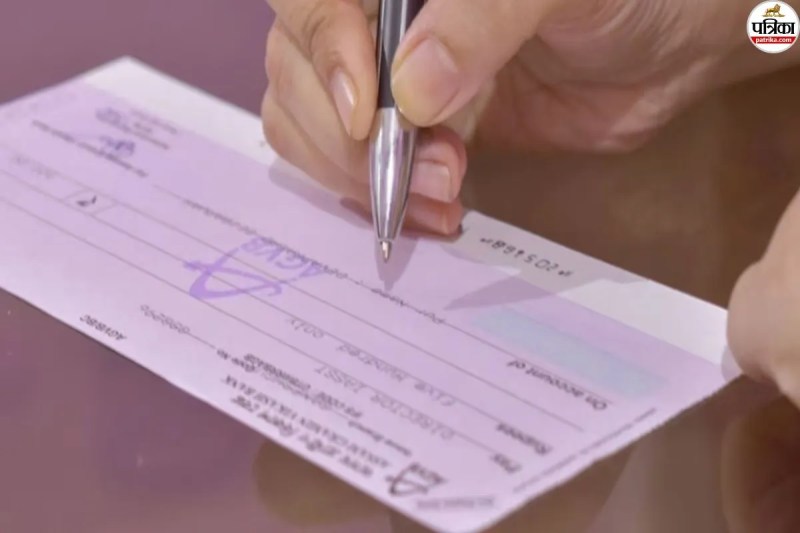
Cheque (Image: AI)
Banking is something you all do, but when was the last time you transacted money using a cheque? Can't recall? It's alright. Very few would remember. This is because people have almost stopped using them, especially for small transactions.
In many places, the use of paper cheques is officially being discontinued. Singapore will stop using paper cheques by 2027. Australia is also set to do the same. Only 0.1% of people there use cheques. After June 30, 2028, Australian banks will stop issuing cheques, and after September 30, 2029, no cheques will be accepted.
Talking about India, according to DataforIndia, twenty years ago, almost everyone used cheques for small transactions. 98.8% of the total transactions in a year were done via cheques. However, by 2024, this has reduced to a mere 8.5%.
2005 - 98.8%
2010 - 92.5%
2015 - 50.7%
2020 - 15.4%
2024 - 8.5%
(Source: DataforIndia)
Despite the continuous decline in cheque usage, emphasis is being placed on reducing the time taken for cheque clearance in India. Arrangements are being made to clear cheques across the country within three hours. The Reserve Bank of India (RBI) had taken a significant step in this direction on October 4, 2025, and launched the first phase of the faster cheque clearing system. The second phase was to be implemented from January 3, 2026, but on December 24, the RBI announced its postponement until further notice.
Under the new system, banks are required to approve or reject a cheque within three hours of receiving it. Customers can deposit cheques at banks between 9 AM and 3 PM. Their cheques will be approved or rejected within three hours. If approved, the money will be credited/debited within the next hour. Banks must complete this process by 7 PM at all costs. Failure to do so will result in the cheque being considered approved by the respective bank.
Since the introduction of NEFT (National Electronic Funds Transfer), the need to use cheques has rapidly decreased. NEFT allows money to be transferred from one account to another anywhere in the country within minutes, at any time, on any day, without any hassle or cost.
With the advent of UPI (Unified Payments Interface), the need for cheques for small amounts has been eliminated. Money can be transferred from one account to another in the blink of an eye with just one click. You can instantly send money using a UPI ID or QR code.
The primary reason for the decline in cheque usage is the growing popularity of digital methods. Between July and September 2025, the number of UPI transactions reached 59.33 billion, a 33.5% increase compared to the same period in 2024. In the three months from July to September 2025, UPI transactions amounted to ₹74.84 trillion.
While the increase in digital money transactions has brought convenience to people, it has also led to a significant rise in fraud. According to DataLeads, cybercriminals defrauded Indians of ₹22,842 crore in 2024. In 2023, fraud amounted to ₹7,465 crore, and in 2022, it was ₹2,306 crore. In 2025, this amount of fraud is estimated to exceed ₹1.2 lakh crore.
Although cheque usage has decreased in the era of digital payments, a large number of cheque bounce cases still occur. By October of this year, there were 5.55 lakh pending cheque bounce cases in the lower courts of Delhi alone. One lakh cases were filed in just nine months, averaging about 370 new cases daily.
The history of cheques is quite old. In the 13th century, a system of payment by cheque was introduced in Venice for international trade. The cheque as we see it today also has a history spanning hundreds of years. An auction website, Sotheby's, mentions a cheque dated April 22, 1659. It is described as the oldest form of the cheque in its current format. This handwritten cheque for ten pounds bears the signature of Nicholas Vanacker. It was drawn by a company founded by Robert Clayton and John Morris.
Big News
View AllBusiness
Trending