26 March 2026,
Thursday


26 March 2026,
Thursday
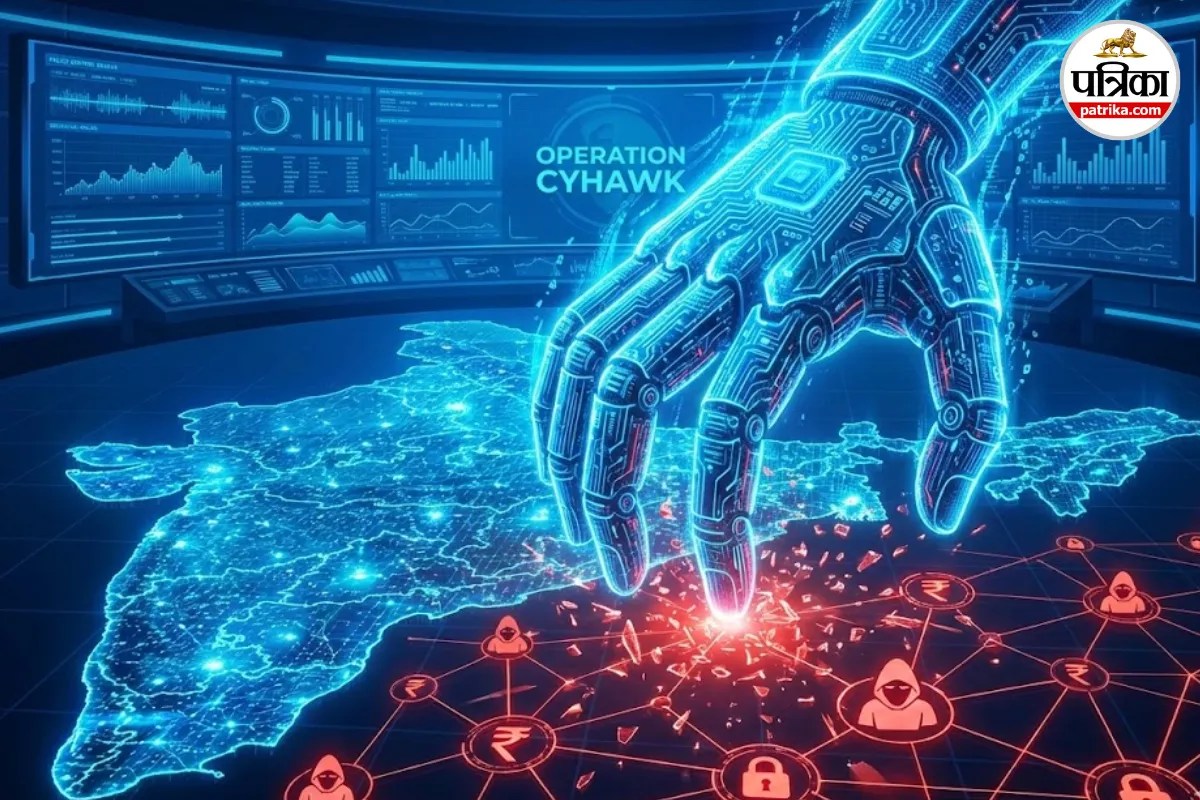
Operation CyHaw (Image Source: Gemini)
Operation CyHawk: While you may have heard many stories of small gangs like Jamtara in the world of crime, the scale of the network that the Delhi Police has now busted will leave you astonished.
When police vehicles simultaneously sped across 10 different states of the country recently, no one had any idea what was about to unfold. More than 5,000 police personnel and cyber sleuths were on a secret mission. The objective was to cripple cybercriminals, and it was named Operation CyHawk.
The truth that emerged in this operation, lasting just 48 hours, shocked even the investigating agencies. Police have detected suspicious transactions worth approximately ₹944 crore with the help of Artificial Intelligence (AI).
Often, the police apprehend those who make fraudulent calls asking for OTPs. However, this time the strategy was entirely different. A senior Delhi Police officer stated that our aim was not to catch the visible faces, but to dismantle the system that keeps this illicit trade alive.
The police directly struck the money trail. This involved individuals who provided fake bank accounts (mule accounts), handled cash, or sold fake SIM cards.
The most startling revelation during the investigation pertained to mule accounts. In simple terms, these are bank accounts that are often opened in the names of poor labourers, students, or people from rural areas. The account belongs to someone else, but the ATM card and net banking are used by cybercriminals.
The investigation revealed that money was being transferred back and forth in these accounts hundreds of times daily. As soon as the money arrived, it was immediately sent to other accounts, and finally converted into cryptocurrency and sent abroad to evade police detection.
It was impossible for human eyes to sift through such a massive amount of data. This is where AI (Artificial Intelligence) came into play.
When the police fed the data of suspicious accounts into AI tools, the pattern became clear. AI identified accounts that were active simultaneously and where money was being transferred at a very high speed. This operation was initiated after analysing 4,058 complaints received on the National Cybercrime Reporting Portal (NCRP).
This operation, which began on December 10, was not limited to Delhi. Its reach extended to Uttar Pradesh, Haryana, Maharashtra, Karnataka, Telangana, Gujarat, Bihar, West Bengal, and Assam. Thousands of SIM cards, obtained on fake IDs and used for fraud, were seized.
The success of Operation CyHawk has given the government a new direction. Preparations are underway to create a permanent National Anti-Fraud Framework. Under this, a centre (Financial Data Fusion Centre) will be established where banks, police, telecom companies, and wallet apps (like Paytm/PhonePe) will work together. This means that as soon as a fraud occurs, data will be shared in real-time, and money can be blocked.
Big News
View AllTechnology
Trending