13 September 2026,
Sunday

13 September 2026,
Sunday
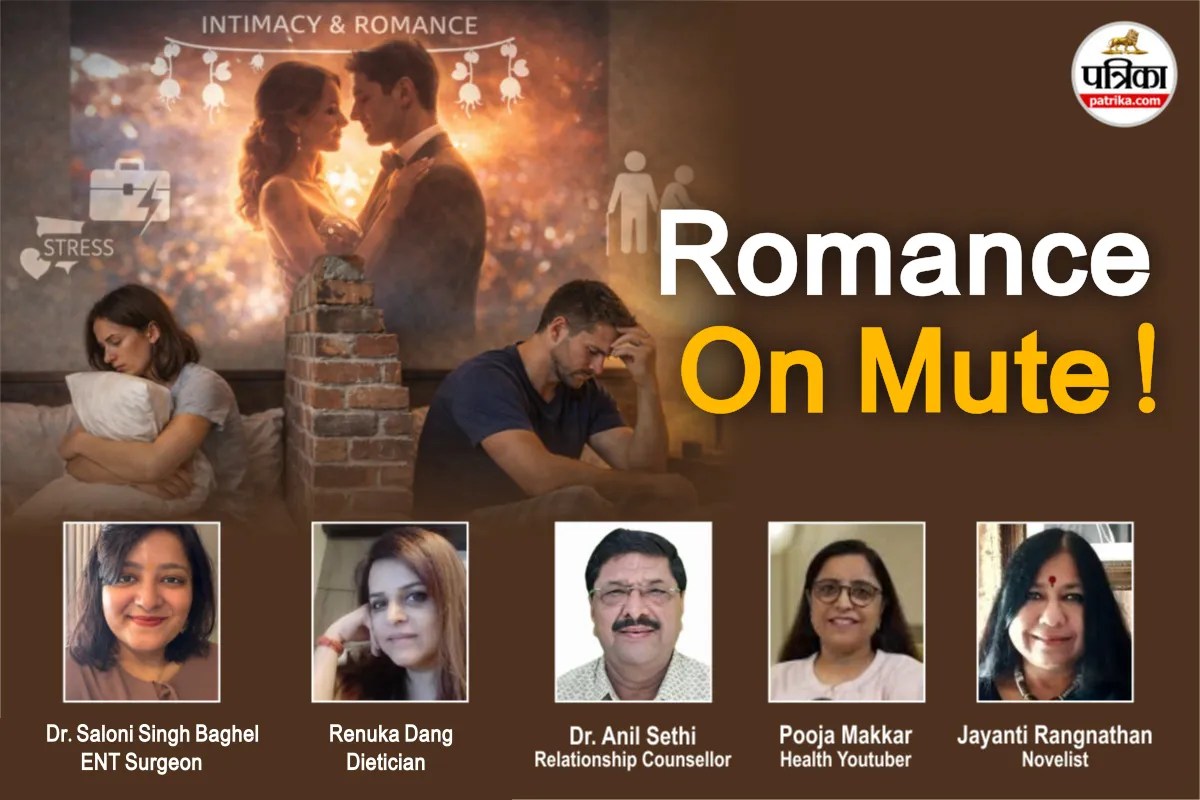
Image: Patrika
Romance, which is often seen on the big screen, seems to be fading in real life. Most people living together under one roof are not united in mind and body. While changes in thoughts and perspectives over time are normal, the absence of intimacy and romance from life is not a good sign, as romance is also seen as a stress buster in human life. There can be several reasons for this change, such as professional life dominating personal life, stress becoming a common problem, and lifestyle changes. Additionally, 'age shift' is also a major reason. Earlier, ideas of romance typically took shape only after adulthood, which is why warmth in relationships lasted longer. But now, understanding that used to come late is arriving early. The flower of romance blooms quickly and starts to saturate by the time one reaches a mature age.
This problem is not limited to India alone. America, considered much more modern than us, is also experiencing this change. A report by the Institute of Family Studies (IFS) indicates that in the 1990s, 55% of adults aged 18 to 64 were intimate once a week. By 2010, this figure dropped to 46%, and in 2024, it further declined to 37%. The decreasing warmth in relationships is being observed not only in married couples but also among young couples. The report suggests that the advent of the digital world has impacted romance. Social interactions are shrinking, and people have confined themselves to the digital world. Where once emotions were exchanged at bedtime, that space has now been occupied by OTT platforms like Netflix.
The situation has indeed become such that it forces us to wonder if we are truly becoming robotic. If we look around ourselves, we can find many people who are unknowingly going through similar situations. Many relationship counselors are also noticing this change. They believe that in today's times, we are living in a robotic state, where due to work pressure and stress, we don't have much time to think beyond work.
Relationship Counselor Dr. Anil Sethi explains that the increasing trend of alcohol consumption among youngsters has changed their lifestyle, and they now view alcohol consumption as a stress buster. He gives an example, stating that just last week, he counselled three young individuals who are now getting married in their late 30s, with the objective of family creation to manage their wealth. Dr. Sethi says that Western culture has always had a lot of pleasure and romance, and following their example, our youth are also engaging in these activities from their teenage years. Therefore, he views this from a different perspective; he considers it a kind of age shift. Today, young people get involved in such activities from the age of 15, which in the nineties used to be around 22 to 25. As a relationship counselor, he can certainly say that extramarital affairs are increasing significantly in our society, partly because relationships are no longer considered taboo. Partners do not view them with guilt either. In such situations, it is common for both partners to get involved with others separately.
Meanwhile, Dietitian Renuka Dang connects this change among youngsters to their eating habits. She states that today, both partners work professionally, and consequently, eating and cooking habits have changed significantly. In the era of Zomato and Swiggy, people do not want to invest time in these habits. As a result, tech-based superfoods are being consumed more. Fancy foods have also altered our taste buds, and this has a direct impact on our personal lives. It is also important to mention here that while pleasure within the spousal relationship might be less evident in this modern culture, as this new society evolves, people are also getting involved beyond marriage; many such cases have been observed.
Health YouTuber Pooja Makkad views this subject from a different perspective. She believes that due to changing approaches and parental acceptance on many issues, today's youth get involved in pleasure before adulthood. Consequently, they do not have the same craze for post-marriage life as we did in our time.
Dr. Saloni Singh Baghel states that today, the measure of everyone's success is best performance, and thus, all energy is directed towards professional life rather than personal life, leading to this outcome. Especially after the post-COVID era, people have reduced investing in emotions and have become emotionally reserved, resulting in less engagement time with their partners. Romance requires time, but pleasure is available with a right swipe. We have created a notion that money is needed for a happy life, and money comes from work. Therefore, after giving 100% on the professional front, a person is emotionally 0% available at home. They now prefer shortcuts for short-term pleasures, whether it's from watching something or buying something. Hence, most people are now operating on automatic mode.
Writer Jayanti Ranganathan clearly states that while pleasure time in married life has decreased, live-in relationships, situationships, and dating apps have given it a new dimension. She believes this trend is less prevalent among people over 30. Today, teenagers have a lot of exposure. Most youth become adventurous during their college life. She says that for this reason, people in middle age are now focusing more on sustainability. However, it must be understood that the Indian family is no longer like Sooraj Barjatya's 'Hum Saath-Saath Hain,' where everyone was upholding idealistic relationships.