24 May 2026,
Sunday

24 May 2026,
Sunday
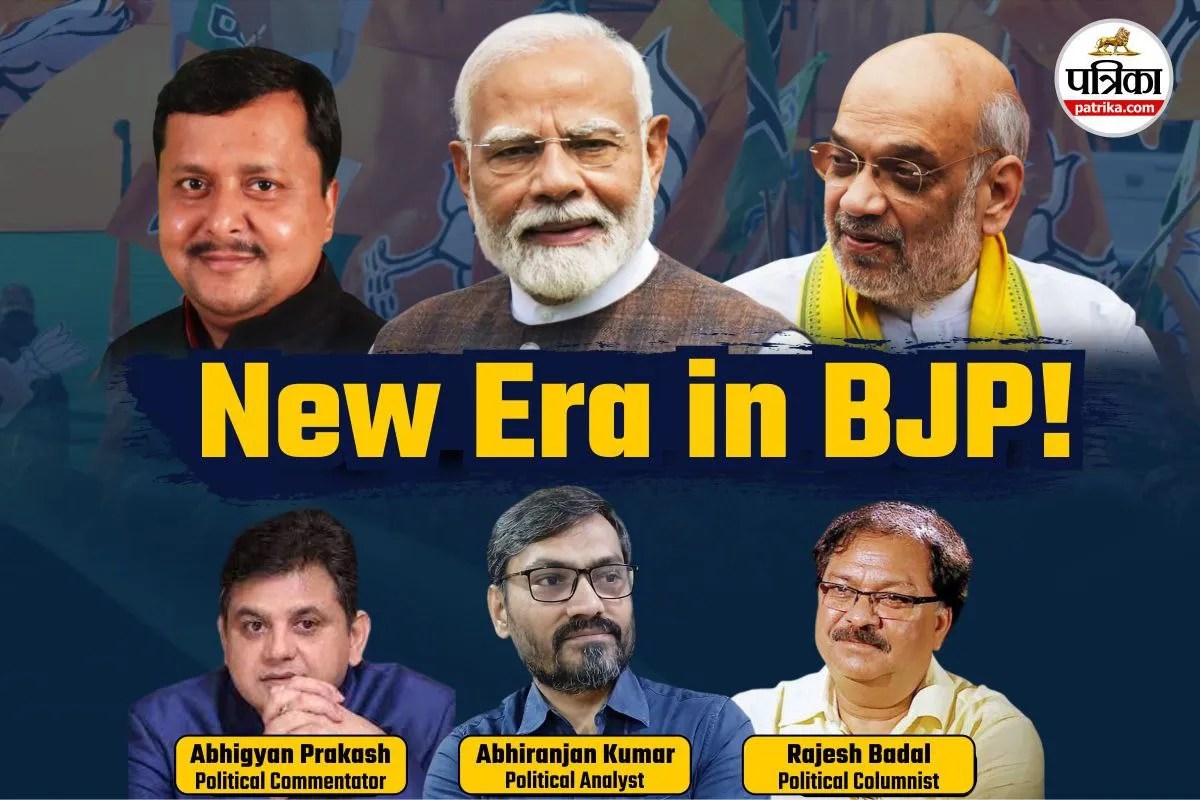
BJP's Generational Shift (Image: Patrika)
The Bharatiya Janata Party (BJP), the world's largest political party, has announced Nitin Naveen as its new national working president and Pankaj Chaudhary as the president of Uttar Pradesh, the country's largest state. This move suggests that a new BJP structure is likely to emerge a decade after 2014. Notably, Nitin Naveen is currently 45 years old, meaning he will not even be fifty by 2029. This age bracket is believed to be the focus for the BJP's new team, which will be responsible for the 2029 elections. Let's explore the perspectives of several senior political commentators who have been analysing Indian politics for decades:
Political commentator Abhigyan Prakash states that there's an old saying about the BJP: 'Meetings, meals, and rest are the BJP's only activities.' However, looking at history, the truth is that contrary to this saying, the party has made significant and transformative decisions multiple times in response to the times, circumstances, and situations. The biggest political transformation decision was made during the Babri Masjid demolition when the party made Lal Krishna Advani its most prominent face. However, at that time, the then Uttar Pradesh BJP chief, Kalyan Singh, could not bring the BJP government to power in the 1993 elections. Instead, Mulayam Singh Yadav and Mayawati formed the government by bringing together caste equations in UP. The message for the BJP was clear: they could not form a government based solely on Hindutva at that time and needed to consider alliances. Therefore, in 1995, showing a major transformation, the BJP made its liberal face, Atal Bihari Vajpayee, its prime ministerial candidate, not the hero of the Ram Mandir movement, Lal Krishna Advani. Subsequently, Vajpayee, through his popular parliamentary speeches, explained why the BJP was considered an 'untouchable' party. This was a major decision for change, with deep-seated reasons behind it.
I firmly believe that changing after studying the 'Mood of the Nation' is a BJP practice, so I don't consider this anything new. The decision to make Modi the prime ministerial face in 2013, followed by the BJP's first majority government, is also proof of this. In my book 'Lucknow to Lutyens,' I have mentioned another significant change: how the BJP made a leader from Gujarat, Amit Shah, the party's general secretary and in-charge of UP. At that time, stalwarts of politics questioned what he could achieve and what he would understand about UP. However, this major decision had a significant impact on Uttar Pradesh politics, with the BJP dominating the state for ten years. The victories in 2014, 2017, 2019, and 2022 are proof of this. It is important to remember here that in 2017, Yogi Adityanath's image was not what it is today, nor was the election fought projecting him as the Chief Minister.
In such a scenario, the BJP has repeatedly made tough and clear decisions for change. I have not even one percent doubt that handing over the party's reins to the 45-year-old Nitin Naveen is also a major decision linked to this. No BJP president will merely be a rubber stamp. Under the guidance of the central leadership, they will work towards leading the BJP to victory in 2029 and will form a new executive accordingly, in my assessment. The party faces elections in several major states within two years. Therefore, what happened before has happened again. The party does not let anyone get a whiff of its bold decisions, and the BJP will leverage this leadership change to its advantage.
Senior journalist Abhiranjan Kumar, who has been closely observing Indian politics for three decades, states that it is true that the BJP of Atal and Advani has changed considerably. Winning elections has now become the party's priority over integrity. Elaborating on this, I would like to make two points regarding the young age of the BJP's working president. As is known, Prime Minister Modi had announced from the Red Fort that he would bring one lakh youth into politics. If Nitin Naveen's selection is in this vein, it will be considered that the party is moving towards Gen Z. However, if he is symbolic as the working president, then there will be no significant creation of a new BJP. It is also important to mention here that the question of whether those being brought forward in the name of young leadership are the next generation of political leaders or if common youth are becoming part of it, is a very thought-provoking one. It will be determined by this whether the party is going to change its structure by promoting young cadres.
Political analyst Rajesh Badal explains that the BJP of Atal, Advani, Jaswant Singh, Sikandar Bakht, and Bhairon Singh Shekhawat witnessed the gradual formation of post-independence India. They saw Nehru shaping the country as its architect. In such a context, they largely refrained from heavily criticising Nehru. The BJP after 2014 did not follow the policy of its architects. Gradually, the BJP has started adopting policies contrary to its foundations. The BJP of 2014 had witnessed the Emergency, and based on that, this generation broke the decorum in criticising Indira and Rajiv compared to the first generation. Now, coming to your original question, the new president Nitin was born five years after the Emergency, and he did not experience that era. Therefore, how he will lead politics from here can be understood from recent statements. It is also a big question how much this new generation will follow the core principle of 'Integral Humanism' of Deendayal Upadhyaya. We are continuously observing that the new trend regarding BJP presidents is not even following the rule of election. In such a situation, I do not see them as seasoned players of politics.
I see this in a way that certain lobbies are now being created within the party. Talking about the leaders of the new generation, many have come from Congress and other parties and have no connection with the Rashtriya Swayamsevak Sangh. In this context, it can be seen as the 'Congress-isation' of the BJP. Leaders from other parties also hold sway in the government. Therefore, my assessment is that this generation, which has come based on new experiments, is not capable of taking the party to new heights. I state clearly that the 'Transformation of BJP' will be ineffective because these leaders lack popular support, and this is not just a phase for the BJP but for all of Indian politics, where the lack of popular young leaders is a major crisis.
Big News
View AllNational News
Trending