21 March 2026,
Saturday


21 March 2026,
Saturday
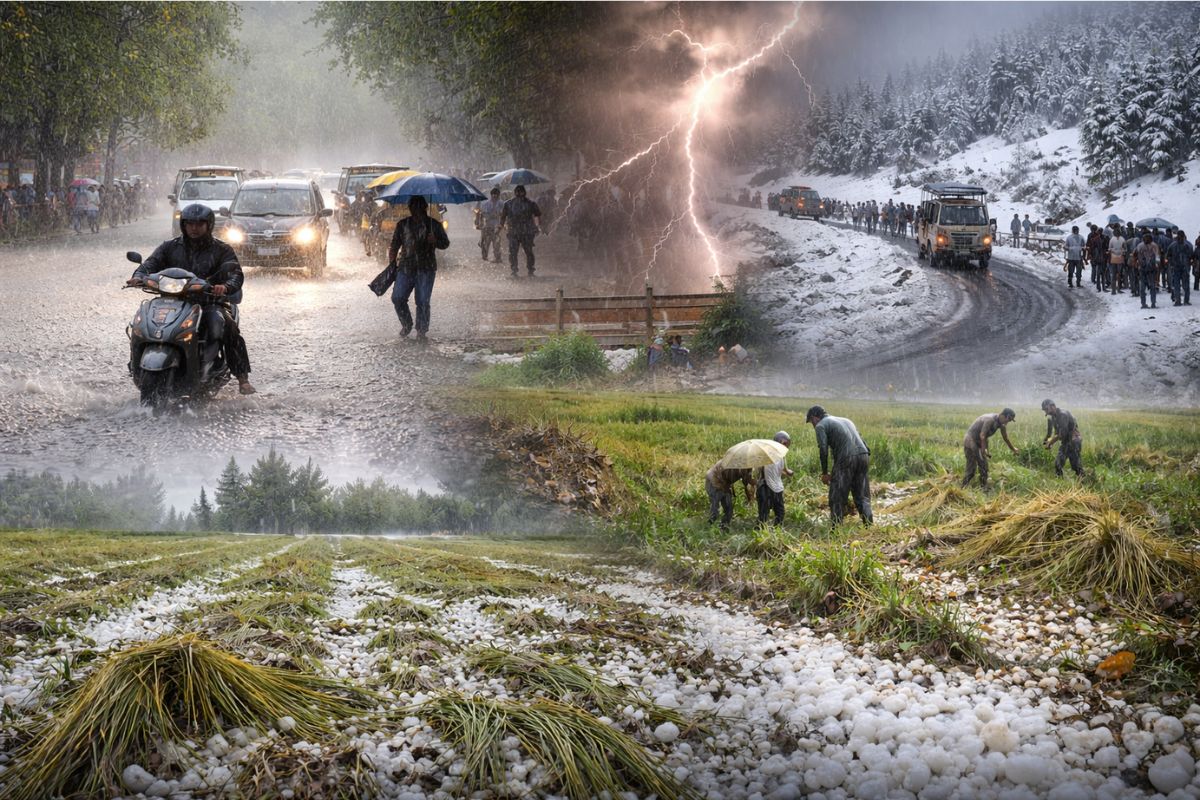
Weather Update: Moderate to heavy rainfall was recorded across states from north to south and west to east and northeast on Friday, the third consecutive day, due to the influence of a strong and unusual Western Disturbance. Snowfall continues in the Himalayan range. This has put a brake on the heat and brought coolness to the weather. Rainfall and hailstorms occurred at many places in Rajasthan. On Friday, it rained with thunder in many areas including the capital Jaipur, Kota, and Sikar. The temperature dropped by up to 10 degrees in some places. Delhi-NCR experienced rain from the morning, making the roads slippery. Incidents of lightning strikes were recorded. Sudden heavy rains and fog were observed in Punjab, while Lucknow received scattered showers with thunder.
According to the Meteorological Department, the structure of this Western Disturbance appeared unusual. A straight trough (low-pressure line) 1,000 kilometres long extended from Afghanistan through Pakistan into India from west to east. Normal disturbances are curved, but this one is in a straight and strong line. This has made the weather stormy with intense thunderstorms and strong winds from the northwest to the eastern parts. Weather expert Navdeep Dahiya said that a day of light winter has returned to North India. He stated that the maximum temperature in Delhi-NCR, Haryana, Punjab, Chandigarh, Rajasthan, and Western Uttar Pradesh would be between 16-22 degrees, which is 10-15 degrees below normal. According to IMD, there is a possibility of daytime temperatures remaining below normal for the next week in many parts of the country due to widespread thunderstorm activity and the influence of the Western Disturbance. The impact of the changed weather in North India will last until March 27. After this, the temperature will gradually increase.
In Gwalior, Madhya Pradesh, the weather on Friday felt cool during the summer days for the first time in 15 years. Rainfall was recorded in 42 districts of the state, while hailstorms in 13 districts caused damage to standing and harvested crops. Wheat and gram crops were particularly affected. In many districts, strong winds, rain, and hailstorms also caused damage due to falling trees and power outages.
Amidst heavy rainfall and heavy snowfall on high peaks in Himachal Pradesh, an avalanche occurred on Friday from a hill about 1.5 kilometres ahead of Triloknath Zero Point, falling into the Chenab River. This increased the river's flow. Traffic was disrupted on three National Highways, including Manali-Kullu, Ani-Kullu, and Rampur-Kinnaur, and 100 other roads. The Atal Tunnel-Rohtang road and the Ani-Kullu Jalori Jot are closed due to 45 cm of snowfall. The Rampur-Kinnaur National Highway is closed due to a landslide in Nathpa.
Big News
View AllNational News
Trending