21 October 2026,
Wednesday

21 October 2026,
Wednesday
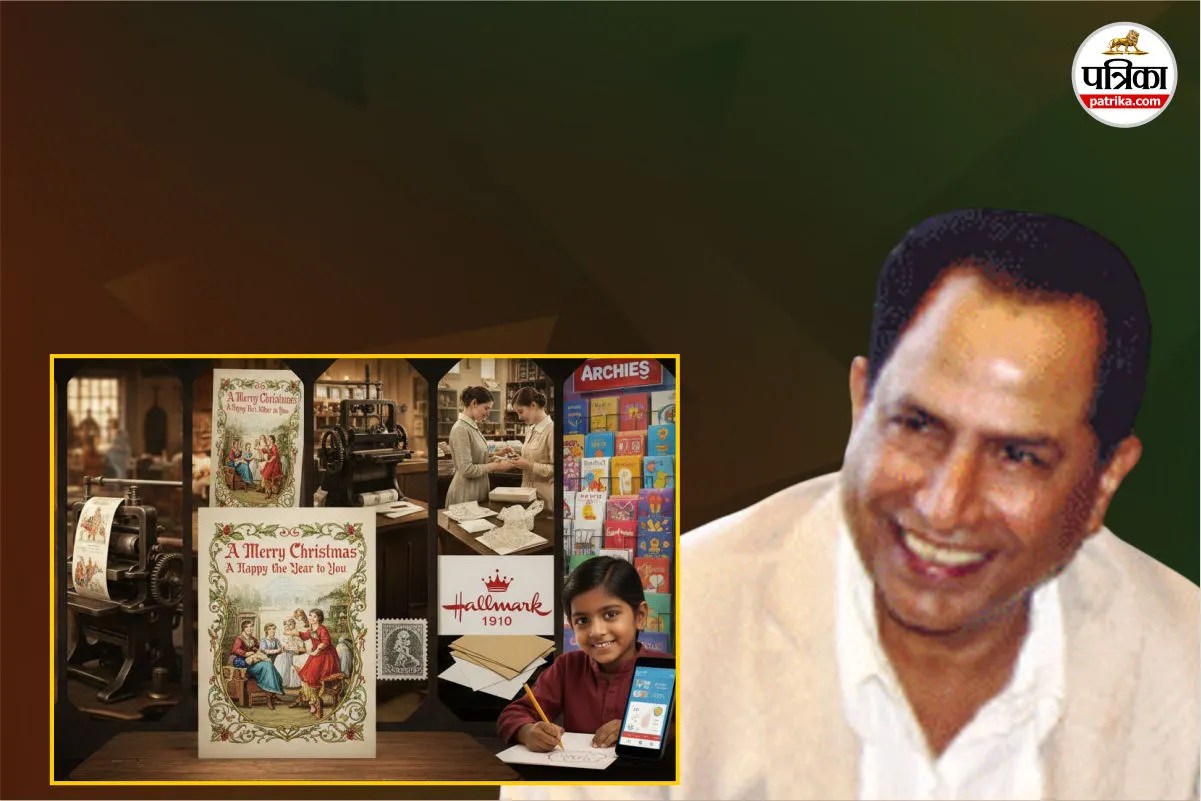
Image: Patrika
Greeting cards were incredibly popular in India during the 1980s and 90s. Whether for films of that era, New Year, or Valentine's Day, greeting cards were ubiquitous. The man behind this phenomenon was an Indian who used to sell posters by the roadside. He then took a loan of ₹5,000 to start a greeting card business, and soon, greeting cards reached every household in India, transforming him into the owner of a multi-crore company. Let's read the story of greeting cards, from their history to their widespread popularity in India, on the occasion of New Year 2026.
Let's travel to 19th-century Britain. Sir Henry Cole, a civil servant in London, was a government official. In those days, long handwritten letters were sent to convey Christmas wishes. Henry was a sociable and influential person, which is why people liked him. By December 1843, Henry Cole had received so many letters that it seemed impossible to reply to them all.
At such a time, he thought of doing something new that would allow him to send greetings to everyone in a shorter time.
To accomplish this, he called upon his friend and renowned artist, John Callcott Horsley. Henry asked his friend to create an illustration, and Horsley designed a card depicting a family celebrating. The card bore the inscription: "A Merry Christmas and a Happy New Year to You".
Henry was delighted with the result. His friend had created exactly what he envisioned. Without delay, Henry Cole had 1,000 such cards printed and sent them to his friends. The remaining cards were sold for one shilling each. This marked the advent of the world's first commercial greeting card.
Greeting cards are merely a medium; the tradition of conveying messages dates back to ancient times. In ancient Egypt, people wrote messages on papyrus leaves, while in China, wishes were exchanged during the 'Lunar New Year'. In medieval Europe, handmade cards were in vogue, but they were very expensive and thus limited to the wealthy.
The history of paper Valentine cards dates back to the 16th century. The first printed Valentine was likely the frontispiece of the book 'A Valentine Writer', published in 1669, which was a collection of poems.
In 1800, hand-painted copperplates created by artists like Francesco Bartolozzi became highly sought after.
Furthermore, in 1840, with the introduction of 'Penny Postage' (affordable postal service) and envelopes in England, the exchange of Valentine cards increased significantly.
Greeting cards entered India along with the British. They were the ones who brought greeting cards to India. Towards the end of the 19th century, when the British began settling in India, cards were exchanged with England for Christmas and New Year. Subsequently, these cards found their way into the royal families of India.
We Indians love to send messages. Therefore, printing presses in India began printing greeting cards according to the festivals.
In 1979, a 19-year-old Delhi University graduate made waves in the Indian greeting card business. Anil Moolchandani, who used to sell posters and help his father in their saree shop, had an idea. In 1981, he opened a small shop in Kamla Nagar, Delhi, with a loan of ₹5,000. This marked the beginning of the greeting card business.
This young man started a company named Archies with ₹5,000 and grew it to ₹100 crore. Even in the age of social media, the company's valuation is reported to be around ₹70 crore. It is thanks to this company that greeting cards reached every household in India.
The popularity of greeting cards has diminished, but they have not disappeared. Greeting cards are still sold on many online gifting stores today. Therefore, it would be incorrect to say that the era of greeting cards is over.
Do you still send messages via greeting cards?