24 August 2026,
Monday

24 August 2026,
Monday
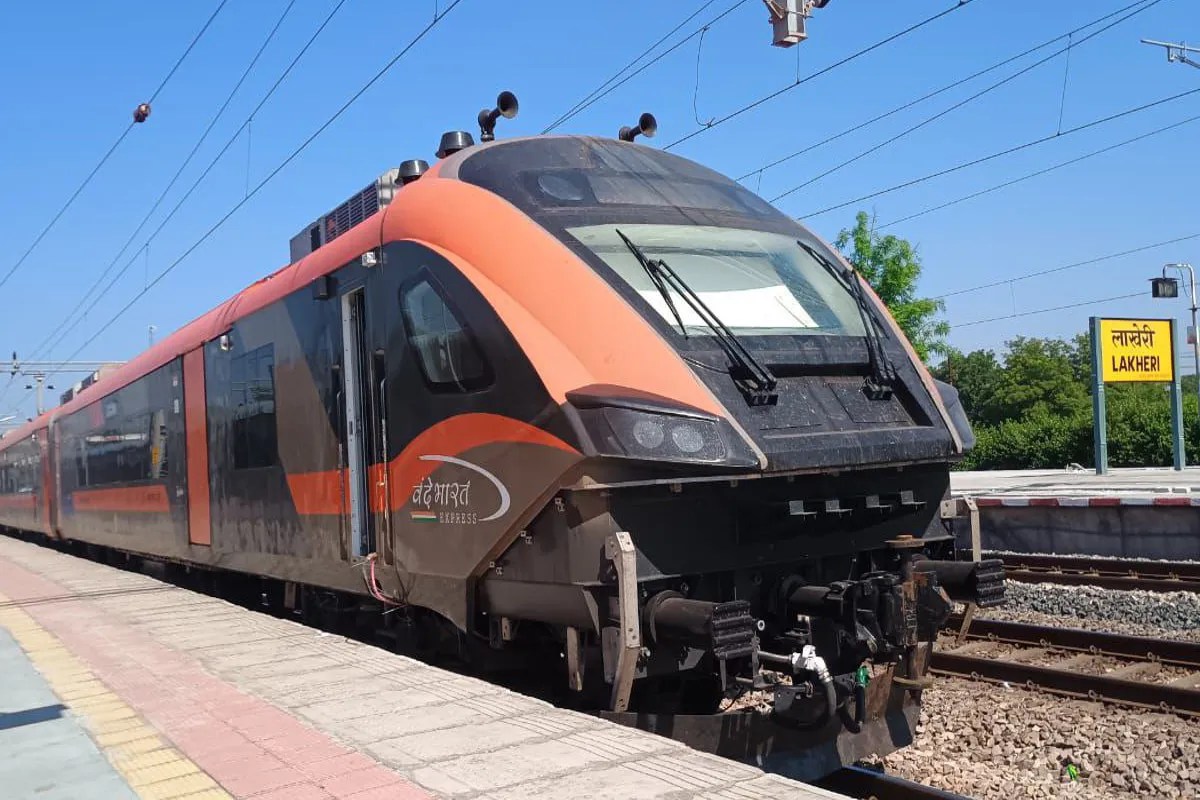
Vande Bharat Train (Image: Patrika)
Kota. The emergency braking distance test of the indigenous technology-based Vande Bharat Sleeper Train (Version-2) of Indian Railways was successfully completed in the Kota Rail Division of West Central Railway. This test was conducted on Saturday on the Kota-Lakheri-Kota section at a maximum speed of 160 km per hour in a loaded condition.
Senior DCM of Kota Rail Division, Saurabh Jain, informed that this test was conducted by a team from the Research Designs and Standards Organisation (RDSO), Lucknow, in which Integral Coach Factory (ICF), Chennai, Medha Servo Drives, Faiveley India, BEML, and the operational team of the Kota Division jointly participated. The testing work was attended by RDSO Lucknow Director Radheshyam Tiwari, Kota Division's Loco Pilots Manoj Meena and Vipin Kumar Singh, along with Chief Loco Inspector RN Meena and Traffic Inspector Sushil Jethwani.
This test was conducted in both dry and wet conditions. To wet the track, water tanks of 500-500 litres and pumps were installed in the coaches, from which water was continuously sprayed onto the track ahead of the wheels through pipelines.
This measured the train's braking distance in conditions similar to rain. The test found that the braking distance on a wet track increases by approximately 10 percent compared to normal conditions. That is, if the emergency brake distance in dry conditions is 1000 meters, it becomes approximately 1100 meters in wet conditions.
In this test, the system's response was checked in case the driver remained inactive for 75 seconds. Upon activation of the VCD, automatic emergency brakes are applied, and the train stops at a predetermined distance.
In this test, a train stopped on a gradient was examined to determine how much traction power is required to prevent the train from rolling back when the holding brakes are released. This test confirmed the reliability of the train's rollback protection system.
Jain stated that all these tests of the Vande Bharat Sleeper Train demonstrate the high quality of Indian Railways' technical capabilities and safety standards. The data obtained from these tests will strengthen the operational and safety standards for high-speed trains in the future.