15 March 2026,
Sunday


15 March 2026,
Sunday
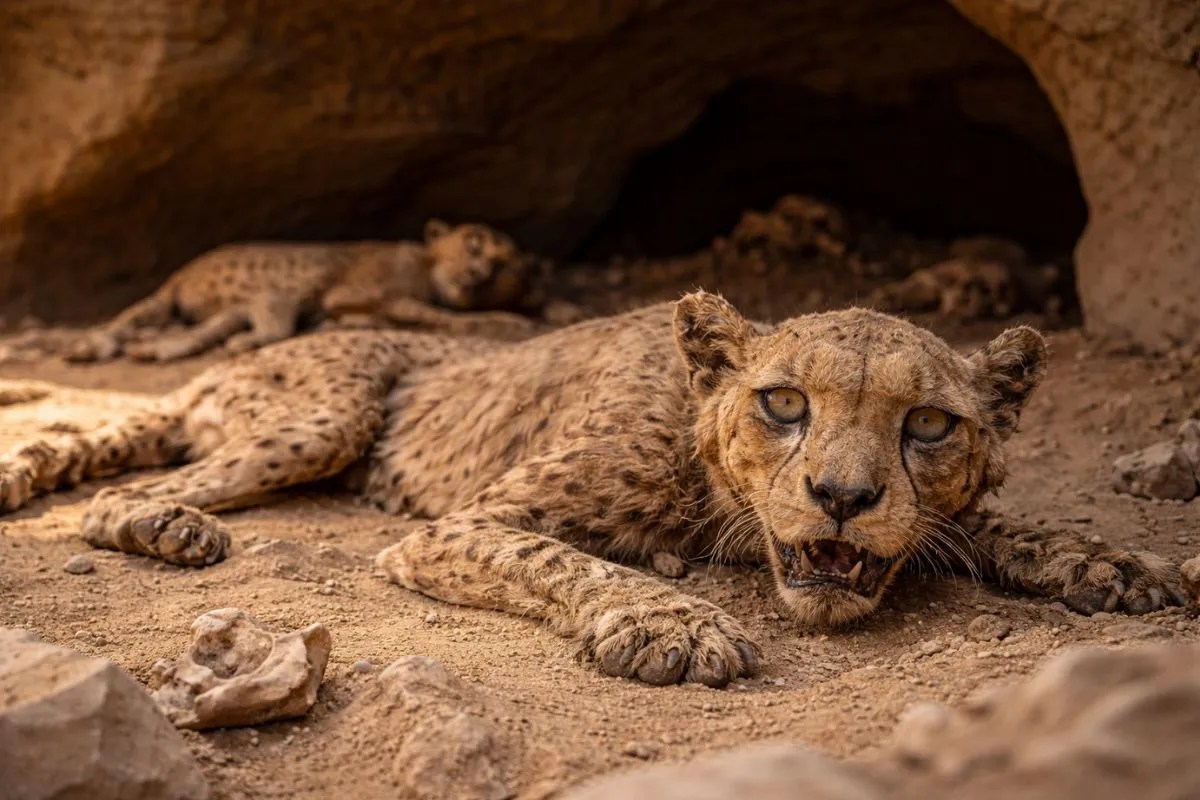
An 1,800-year-old cheetah mummy found in Arar, Saudi Arabia; the naturally preserved remains still show the cheetah’s eyes clearly visible. (AI-generated image)
Researchers have recovered mummified remains of cheetahs from an ancient cave in the desert located in the city of Arar, Saudi Arabia. Among these remains, the faint eyes of one cheetah are visible in a rather terrifying manner. These remains are said to be 1800 years old. According to researchers, this cave holds the history of big cats.
According to researchers from the National Cultural Heritage Centre, Saudi Arabia, a total of seven mummies and 54 other cheetah bones have been excavated near Arar. Experts believe that this cave was likely a permanent habitat for cheetahs, where female cheetahs would give birth to cubs. It is believed that a unique environment within the cave naturally mummified the bodies of these mammals.
Experts from Italy’s University of Florence, including Joan Madurell-Malapera, have expressed surprise over the discovery. For the first time, scientists have successfully extracted DNA from these natural mummies. Genetic analysis of the cheetah remains has revealed that this species was closely related to Asian and north-western African cheetahs. This information is expected to significantly aid efforts to reintroduce cheetahs to the Arabian Peninsula, where they became extinct decades ago.
Alongside the mummified cheetah remains found in a cave in Saudi Arabia, archaeologists have also made a significant discovery in England. Evidence of an ancient Roman industrial centre has been found on the banks of the River Wear. More than 800 stones were discovered at the site, which were used to sharpen blade edges.
Big News
View AllWorld
Trending