23 October 2026,
Friday

23 October 2026,
Friday
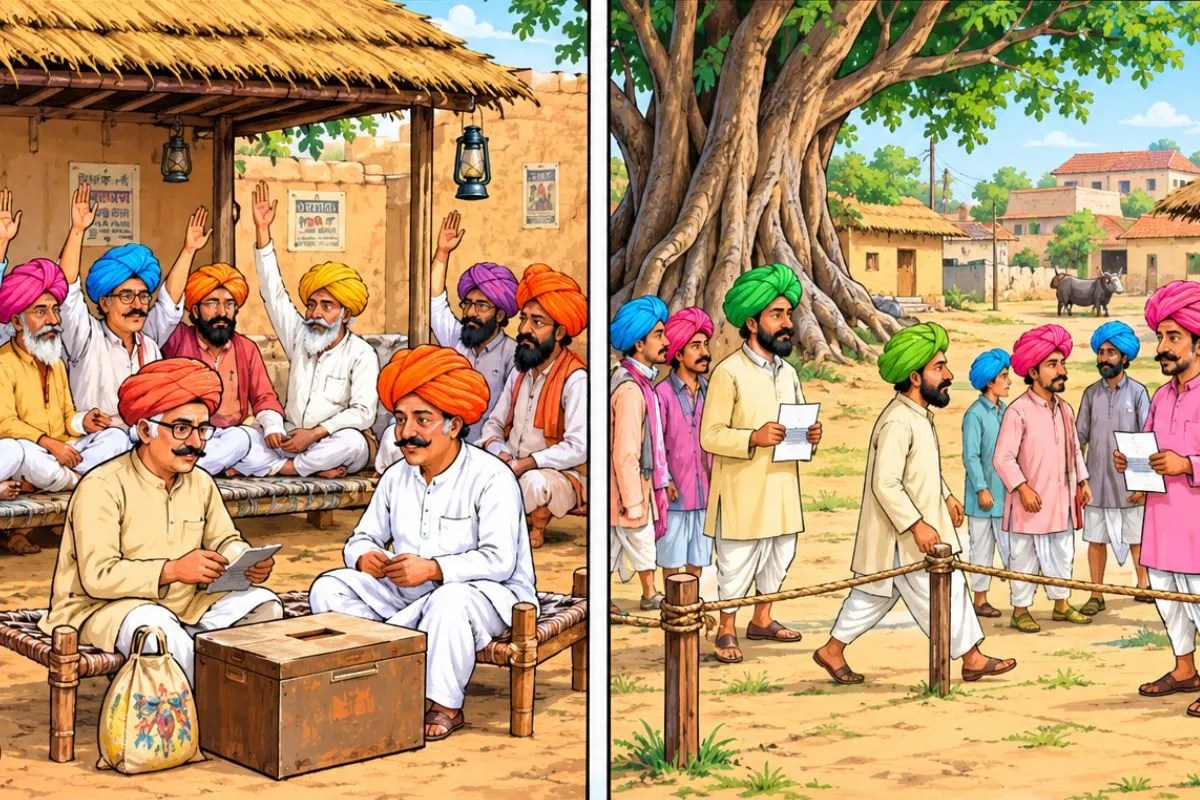
Voting by raising hands in the chaupal and election by crossing the line marked by a rope (Photo: AI)
Charanwasi (Hanumangarh): In the 1960s, village elections in Rajasthan were held without secret voting, ballot papers or EVMs, elderly villagers of the area recalled.
How candidates were declared winners in those days
Harishchandra Godara, 96, of Fefana village, and Banwarilal Joshi, 85, of Chak Joshiyon ki Dhani, said village elections in the 1960s were held in a very simple way. Two main methods were used.
In the first method, all the villagers were gathered at the chaupal (village meeting place) or in an open ground. The names of the candidates in the fray were then called out. The election officials asked supporters of a candidate to raise their hands. The candidate with the most raised hands was declared the winner.
Another method of voting in those days
The second method was even more interesting. A rope was tied across the middle of the ground, and the candidates were made to stand on either side of it.
A voter who wanted to support a candidate crossed the rope and stood on that candidate's side. The result went in favour of the candidate with more people on his side.
Minimal expenses: villagers made the arrangements
Godara and Joshi said campaigning and expenses were minimal in those days. Candidates went from house to house with folded hands, without any fuss.
There were no loudspeakers and no money was spent on banners and posters. The villagers got together and arranged tea and water themselves. Despite political rivalry, brotherhood among them remained fully intact.