6 April 2026,
Monday


6 April 2026,
Monday
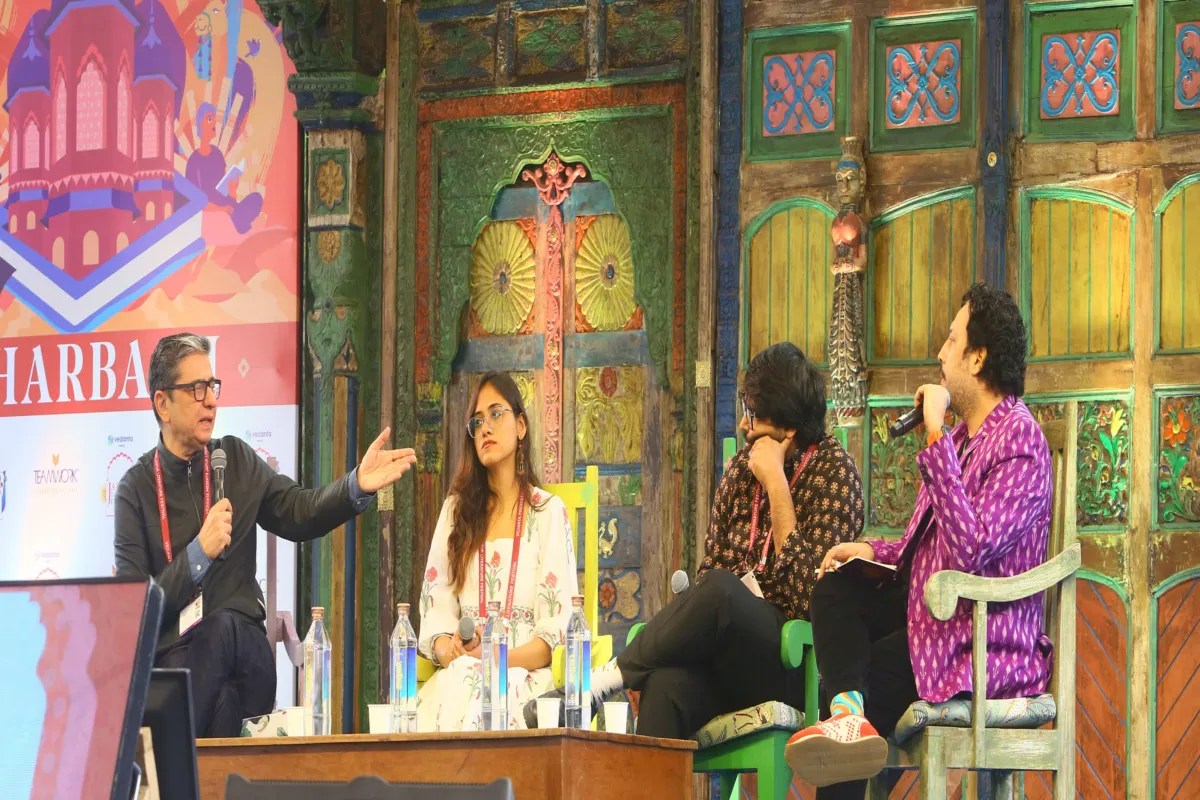
JLF 2026 (Image: Patrika)
A session titled 'Gen Z, the Millennials and Mummyji' held at Charbagh on the final day of the Jaipur Literature Festival discussed the impact of digital culture. Speakers in the session stated that the internet and social media have provided a platform for people's expression, but along with it, tendencies to avoid societal polarisation, confusion, and disagreement have also increased.
Identity is now becoming less about ideas and more about presentation, while love and relationships are adapting to a different language and different rules due to new mediums. Author and cultural commentator Anurag Minus Verma, social thinker Santosh Desai, and writer Riya Chopra shared their views in the session. Chirag Thakkar moderated the conversation.
The discussion began with the question of how we perceive 'truth' on the internet today. Speakers said that facts are presented in such a way today that they gradually become a person's belief, and then that belief is established as a fact. According to the speakers, a major reason for this is algorithms. Algorithms show individuals what they already like. Liking a video or an idea means that similar content will be shown in the future. This process creates an echo chamber, where individuals repeatedly see confirmation of their own thoughts.
Speakers also said that the influence of AI further accelerates this process. If AI constantly agrees with everything, individuals gradually start living in a world devoid of disagreement. However, as soon as they step out of the digital world into the real world, they encounter people with different opinions, different experiences, and different versions of truth.
During this, speakers said that the biggest loss is that the capacity for 'I could be wrong' or 'I can disagree' is weakening. In online debates, people often either cancel or block each other. This further strengthens the echo chamber, creating a fragmented reality, which the speakers termed 'fox truth'.
Discussing the changing nature of truth and trust, social thinker Santosh Desai said that his generation used to perceive truth through institutions. Later generations began to doubt institutions and considered people more trustworthy, but now we are reaching an era where truth has become like a 'vibe', 'mood', and 'ambience' rather than having a solid basis.
He said that surprisingly, people question the content creator but not the algorithm. No one asks, 'Why am I being shown this content?', 'On what basis is my timeline being decided?', or 'What is shaping my thoughts?'
Riya Chopra said that the emotion of love has not changed. People still desire and feel love today, but the medium and language of expressing it have changed. She said that dating apps have increased options. People can now access more partners than before. The forms of relationships have also diversified. Monogamy is no longer the only option. There has been an increased tendency to accept different kinds of relationships, and discussions about legal changes have also occurred, although many problems still exist there.
An interesting change is that today's youth appear more conservative than before. Data and the prevailing atmosphere suggest that young people are becoming more conservative politically as well as sexually and romantically. According to them, one reason for this is that the world seems more insecure and difficult now.
Economic uncertainty, career pressure, anxiety about the future, and the constant state of 'permacrisis' have exhausted young people. Therefore, many are prioritising stability and career over love and relationships. Anurag Minus Verma also drew attention to online gender tension. He said that on platforms like Reddit and Twitter, some male groups exhibit very harsh and hateful language towards the other gender. Healthy offline dialogue is diminishing, and only online interactions are increasing the distance between genders, further complicating the understanding of relationships.
Anurag also said that we are perhaps not as progressive as we thought ourselves to be. Although dating apps have increased access to people of different castes and classes, marriage statistics show that most marriages today still occur within one's own group. Parental choice and social acceptance are still major determinants of relationships.
Anurag Minus Verma said that despite digital self-reliance, the fundamental structures of society have not changed much. In smaller cities, dating apps are still viewed with suspicion, whereas platforms like Shaadi.com are considered socially acceptable.
He said that no matter which app you meet someone on, you ultimately have to go through the same social algorithm: family, caste, class, and acceptance. This shows that the limits of online self-reliance are ultimately determined by offline social structures.
Regarding the internet, he also said that it was initially considered a platform for equality, but the online world has merely replicated offline hierarchies. Caste, class, misogyny, and inequality are just as strongly present on the internet, and sometimes in even more aggressive forms.
Anurag said that Gen Z is under immense pressure to follow trends. They often do not make decisions themselves; online pressure makes decisions for them about what to wear, where to go, what caption to use, and what is considered 'cool'. In this context, he referred to Gen Z as 'cultural mandas' (cultural slowpokes/followers).
In the context of caste, he also explained that new forms of caste identities and myths are being created on digital platforms. Different castes are trying to establish their identity online through videos, songs, and memes. He described this as a kind of digital caste epic, which is rapidly spreading on the internet.
On consumerism and identity, Santosh Desai said that today everyone is constantly presenting themselves. According to him, earlier, it didn't matter who you were, but today everyone has to prove themselves daily.
He said that identity has now become pixelated, and each pixel of identity is a person's small choices: what they wear, what they buy, what they post, where they go. This is why we are constantly creating and recreating ourselves, as if we are living in our own beta version throughout our lives. Referencing John Berger, he said that products address our self-love and then sell that same self-love back to us at a price. Hence, the role of products becomes never-ending.
Riya Chopra said that for today's generation, consumerism is no longer just a necessity; it has become a means of identity. People signal what kind of person they are through clothes, shoes, tote bags, and brands. She also said that schemes like 'Buy Now, Pay Later' and easy credit have made spending simpler. The younger generation is using EMIs for concert tickets and shopping. However, this trend is a cause for concern for both the environment and mental health.
Giving the example of tote bag culture, she said that every brand gives away tote bags, and people use them as a form of identity, but ultimately, these also end up in landfills, and often they are made from polymer-based materials, not organic ones.
At the end of the session, speakers said that while the digital world has provided a platform for expression, truth, relationships, and identity have become more entangled than ever before. Polarisation is increasing due to algorithms, the tendency to avoid disagreement is strengthening, and consumerism is becoming a substitute for identity. According to the speakers, there is a need for society, along with technology, to introspect, understand algorithms, and bring human dialogue back to the centre.
Big News
View AllJaipur
Rajasthan
Trending